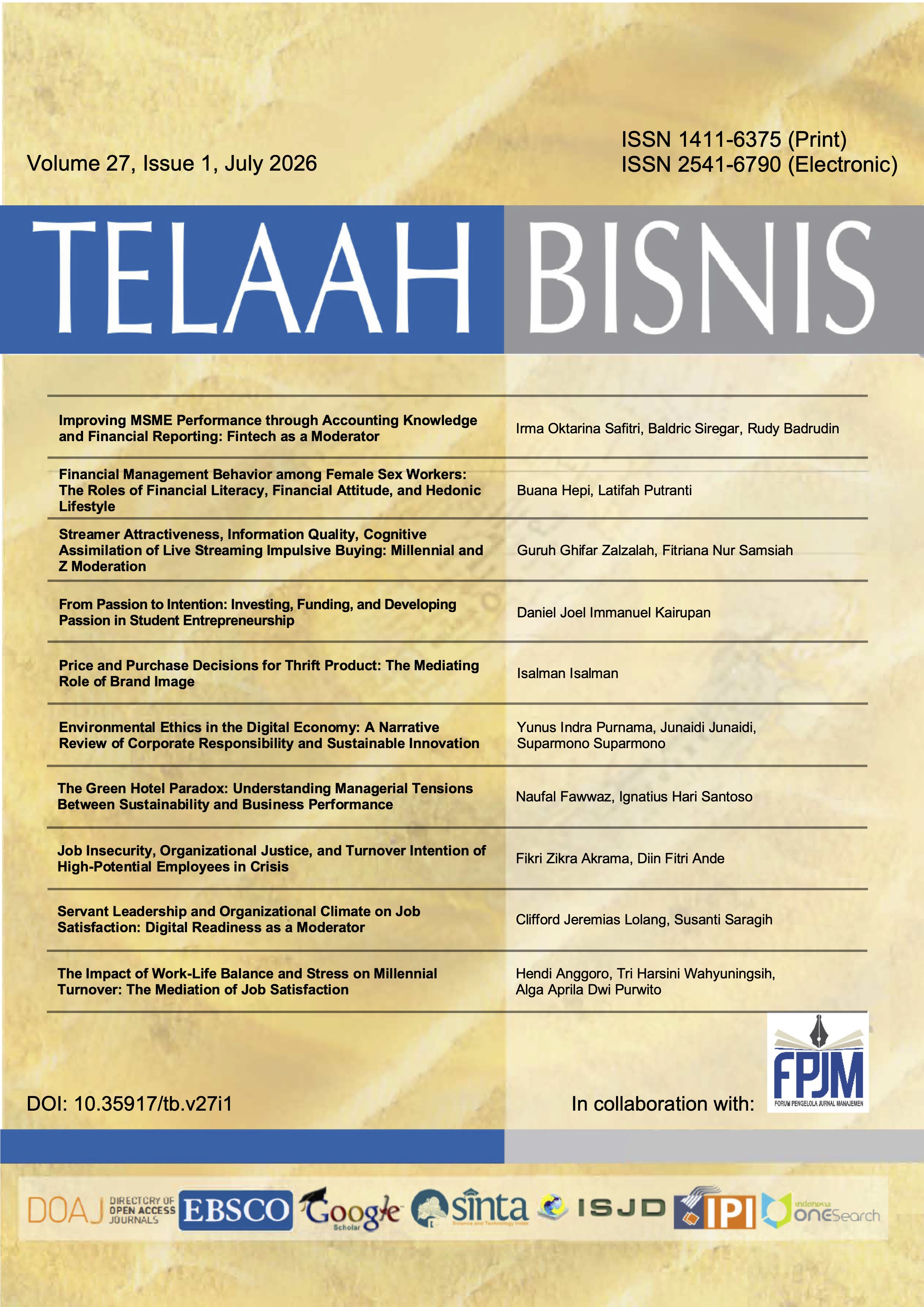
The Impact of Work-Life Balance and Stress on Millennial Turnover: The Mediation of Job Satisfaction
DOI:
https://doi.org/10.35917/tb.v27i1.645Keywords:
work stress, job satisfaction, turnover intention, work-life balance, millennial generation, Karawang industrial areaAbstract
In this study, the researchers analyse whether work-life balance and work stress affect the intention of millennial workers in the Karawang Industrial Area to quit their jobs, with job satisfaction as the factor bridging that relationship. This study conducted this research using non-probability and purposive sampling methods on all millennial workers in the Karawang Industrial Area. There were 143 participants. We collected data by distributing questionnaires. We conducted instrumental tests, normal distribution tests, and classical hypothesis tests, all of which met the criteria. This study uses regression analysis and Process 4.2, a macro analysis program for SPSS 26 developed by Andrew F. Hayes, to verify the hypothesis. This study found that both work-life balance and stress significantly and positively affect employees' intention to quit. These two factors also have a significant positive impact on employee job satisfaction, thereby reducing the intention to quit. It was also revealed that job satisfaction acts as a mediator between work-life balance and stress on the intention to quit. Overall, 70.4% of the variation in the intention to quit can be explained by work-life balance, stress, and job satisfaction, while 29.6% is influenced by other variables outside the scope of the study.
Downloads
References
Adriano, J., & Callaghan, C. W. (2020). Work-life balance, job satisfaction and retention: Turnover intentions of professionals in part-time study. South African Journal of Economic and Management Sciences, 23(1), 1–10. https://doi.org/10.4102/sajems.v23i1.3028
Amri, U. , M. A., & Riyanto, S. (2017). Pengaruh Kepuasan Kerja, Stres Kerja, Dan Komitmen Organisasi Terhadap Turnover Intention Pada Head Office Pt. Thamrin Brothers Palembang. Jurnal Kompetitif Universitas Tridinanti Palembang, 6(1), 109–128.
Antari, N. L. S. (2019). Pengaruh Kepuasan Kerja Terhadap Komitmen Organisasi dan Turnover Intention (Studi Pada Losari Hotel Sunset Bali). Prospek: Jurnal Manajemen Dan Bisnis, 1(1), 31–37.
Aristiyani, A., Nurdin, M. C. I., Megita, M., Assa, V., Sugiarti, L. R., & Suhariadi, F. (2023). Pengaruh work life balance, perceived organizational support terhadap keterlekatan kerja melalui kepuasan kerja sebagai variabel intervening pada anggota instansi X. Jurnal Cahaya Mandalika, 4(3), 1188–1198. https://ojs.cahayamandalika.com/index.php/jcm/article/view/2046
Astuti, D., & Putri, C. A. T. (2023). Peran Mediasi Kepuasan Kerja pada Pengaruh Work Life Balance terhadap Turnover Intention. SEIKO : Journal of Management & Business, 6(2), 482–490.
Badan Pusat Statistik, K. (2020). Hasil Survey Penduduk 2020. https://karawangkab.bps.go.id/subject/6/tenaga-kerja.html
Badan Pusat Statistik Karawang. (2022). Hasil Survey Penduduk. https://www.bps.go.id/publication/2023/10/27/83d4aaefa732e79efa75107b/analisis-mobilitas-tenaga-kerja-hasil-sakernas-2022.html
Delo, T. H. E. , & Te, I. T. (2010). A call for comity. In Renewing Rhetoric’s Relation to Composition (pp. 219–247). Routledge. https://doi.org/10.4324/9780203869222-23
Dewi, P. S. A., & Sriathi, A. A. A. (2019). Pengaruh stres kerja terhadap turnover intention yang dimediasi oleh kepuasan kerja . E-Jurnal Manajemen Universitas Udayana, 8(6), 3646–3673. https://doi.org/10.24843/EJMUNUD.2019.v08.i06.p13
Fisher, G. G., Bulger, C. A., & Smith, C. S. (2009). Beyond work and family: A measure of work/nonwork interference and enhancement. Journal of Occupational Health Psychology, 14(4), 441–456. https://doi.org/10.1037/a0016737
Fitriani, L. K., & Yusiana, N. (2020). Analisis pengaruh kompensasi dan beban kerja terhadap kepuasan kerja dan turnover intention pada karyawan Inti Pangan, Kuningan. Indonesian Journal of Strategic Management, 3(2), 79–88. https://doi.org/10.25134/ijsm.v3i2.3632
Fitriantini, R., Agusdin, A., & Nurmayanti, S. (2019). Pengaruh beban kerja, kepuasan kerja dan stres kerja terhadap turnover intention tenaga kesehatan berstatus kontrak di RSUD Kota Mataram. Distribusi: Journal of Management and Business, 8(1), 23–38. https://doi.org/10.29303/distribusi.v8i1.100
Gayatri, E., & Muttaqiyathun, A. (2020). Pengaruh job insecurity, beban kerja, kepuasan kerja dan komitmen organisasi terhadap turnover intention karyawan milenial. Prosiding University Research Colloquium, 11, 77–85.
Ghozali, I. (2021). Aplikasi Analisis Multivariat (10th ed.). Badan Penerbit Universitas Diponegoro.
Hasibuan, M. S. P. (2016). Manajemen sumber daya manusia. Bumi Aksara.
Ibrahim, R. N., & Suhariadi, F. (2021). Pengaruh Kepuasan dan Stres Kerja terhadap Turnover Intention pada Pengurangan Gaji Karyawan Saat Pandemi. Buletin Riset Psikologi dan Kesehatan Mental (BRPKM), 1(2), 1388–1396. https://doi.org/10.20473/brpkm.v1i2.28619
Koto, M. A., & Arif, M. (2019). Kepuasan Kerja sebagai Variabel Intervening Pada Pengaruh Work-Life Balance dan Stres Kerja Terhadap Turnover Intention. Jurnal Ilmiah Manajemen dan Bisnis, 20(1), 39–51. https://doi.org/10.30596/jimb.v20i1.2987
Laksono, B. F. W., & Wardoyo, P. (2019). Pengaruh Work Life Balance, Kepuasan Kerja Dan Work Engagement Terhadap Turnover Intentions Dengan Mentoring Sebagai Variabel Moderating Pada Karyawan Hotel Dafam Semarang. Jurnal Riset Ekonomi dan Bisnis, 12(1), 17–36. https://doi.org/10.26623/jreb.v12i1.1525
Lubis, N., & Onsardi, O. (2021). Pengaruh Kompensasi, Komitmen Organisasi dan Kepuasan Kerja Terhadap Turnover Intention Pada Pt. Bukit Angkasa Makmur Bengkulu (Studi Kasus Karyawan Produksi PT.BAM Bengkulu). JEMS: Jurnal Entrepreneur dan Manajemen Sains, 2(2), 196–208. https://doi.org/10.36085/jems.v2i2.1549
Luthans, F., Luthans, B. C., & Luthans, K. W. (2021). Organizational Behavior: An Evidence-Based Approach (14th ed.). IAP–Information Age Publishing. Inc.
Makhmut, K. D. I. (2020). Pengaruh Beban Kerja Dan Konflik Peran Terhadap Kinerja Pegawai Kantor Pelayan Pajak Pratama Jember Dengan Work Life Balance Sebagai Variabel Intervening. Universitas Jember. https://repository.unej.ac.id/handle/123456789/101384
Marcella, J., & Ie, M. (2022). Pengaruh stres kerja, kepuasan kerja dan pengembangan karir terhadap turnover intention karyawan. Jurnal Muara Ilmu Ekonomi dan Bisnis, 6(1), 180–191. https://doi.org/10.24843/jmieb.v6i1.18321
Mawadati, D., & Saputra, A. R. P. (2020). Pengaruh kepuasan kerja dan stres kerja terhadap turnover intention karyawan. Forum Ekonomi, 22(1), 18–26.
Mobley, W. H., Horner, S. O., & Hollingsworth, A. T. (1978). An evaluation of precursors of hospital employee turnover. Journal of Applied Psychology, 63(4), 408–414. https://doi.org/10.1037/0021-9010.63.4.408
Nita, P. D. (2022). The Effect Of Work Stress And Work Family Conflict On Turnover Intention With Job Satisfaction As An Intervening Variable. Indonesian Journal of Multidisciplinary Sciences (IJoMS), 1(1), 1–18. https://doi.org/10.59066/ijoms.v1i1.31
Noeary, S. A., Purnomo, A. K., & Waruwu, F. (2020). Kepuasan kerja sebagai variabel mediasi pada pengaruh stres kerja terhadap niat keluar. Jurnal Manajemen Maranatha, 20(1), 31–40. https://doi.org/10.28932/jmm.v20i1.2752
Novel, C., & Marchyta, N. K. (2021). Pengaruh Beban Kerja Melalui Kepuasan Kerja Terhadap Turnover Intention Karyawan Swalayan Valentine Di Kairatu. 9(2), 1–11.
Novitasari, I. A., & Dessyarti, R. S. (2022). Pengaruh Work-Life Balance Terhadap Turnover Intention Dengan Employe Engagement Sebagai Variabel Intervening (Studi Pada Karyawan Po Jaya Ponorogo). Jurnal Ilmiah Edunomika, 6(1), 405. https://doi.org/10.29040/jie.v6i1.4350
Nurdin, S., & Rohaeni, H. (2020). Work-Life Balance and its Impact on Turnover Intention in the Millennium: the Mediation Role of Job Satisfaction. JKBM (Jurnal Konsep Bisnis Dan Manajemen), 121–132.
Omar, M. K. (2020). Work stress, workload, work-life balance, and intention to leave among employees of an insurance company in malaysia. 21(2), 70–78.
Pranata, G. D., & Ketut Netra, I. G. S. (2019). Pengaruh stres kerja terhadap turnover intention melalui mediasi komitmen organisasional pada restoran queen’s tandoor seminyak. E-Jurnal Manajemen Universitas Udayana, 8(6), 3531–3559. https://doi.org/10.24843/ejmunud.2019.v08.i06.p09
Prayogi, M. A., Koto, M., & Arif, M. (2019). Kepuasan Kerja sebagai Variabel Intervening Pada Pengaruh Work-Life Balance dan Stres Kerja Terhadap Turnover Intention. Jurnal Ilmiah Manajemen Dan Bisnis, 20(1), 39–51. https://doi.org/10.30596/jimb.v20i1.2987
Putra, D. M. B. A., & Mujiati, N. W. (2019). Peran Kepuasan Kerja Dalam Memediasi Pengaruh Stres Kerja Dan Motivasi Kerja Terhadap Turnover Intention. E-Jurnal Manajemen Universitas Udayana, 8(7), 4045. https://doi.org/10.24843/ejmunud.2019.v08.i07.p02
Putro, T. A. D., Ajeng, N., & Qomariyah, O. (2020). Stres Kerja, Keterlibatan Kerja, dan Intensi Turnover Pada Generasi Milenial. Psikostudia : Jurnal Psikologi, 9(2), 154. https://doi.org/10.30872/psikostudia.v9i2.3837
Ramlah, S., Sudiro, A., & Juwita, H. A. J. (2021). The influence of compensation and job stress on turnover intention through mediation of job satisfaction. International Journal of Research in Business and Social Science (2147- 4478), 10(4), 117–127. https://doi.org/10.20525/ijrbs.v10i4.1206
Rijasawitri, D. P., & Suana, I. W. (2020). Pengaruh kepuasan kerja, stres kerja, dan lingkungan kerja non fisik terhadap turnover intention. E-Jurnal Manajemen Universitas Udayana, 9(2), 466–486. https://doi.org/10.24843/ejmunud.2020.v09.i02.p04
Septia Ningsih, N. K. W., & Putra, M. S. (2019). Pengaruh stres kerja, kepuasan kerja dan komitmen organisasional terhadap turnover intention pada karyawan. E-Jurnal Manajemen Universitas Udayana, 8(10), 5907–5936. https://doi.org/10.24843/ejmunud.2019.v08.i10.p02
Sismawati, W., & Lataruva, E. (2020). Pengaruh work-life balance dan stres kerja terhadap turnover intention karyawan Generasi Y dengan kepuasan kerja sebagai variabel intervening (Studi pada PT Bank Tabungan Negara Syariah Semarang). Diponegoro Journal of Management, 9(3), 1–11.
Sondakh, J., Rembang, J. H. W., & Syahyuti, N. (2021). Karakteristik, potensi generasi milenial dan perspektif pengembangan pertanian presisi di Indonesia. Forum Penelitian Agro Ekonomi, 38(2), 155–166. https://doi.org/10.21082/fae.v38n2.2020.155-166
Sugiyono. (2019). Metode penelitian kuantitatif, kualitatif, dan R&D [Quantitative, qualitative, and R&D research methods] (D. Sutopo & Ir. MT, Eds.). Alfabeta.
Sutagana, I. N. T., Ernayani, R., Liow, F. E. R. I., Octiva, C. S., & Setyawasih, R. (2023). Analisis Pengaruh Paket Remunerasi dan Stres Kerja terhadap Turnover Intention dengan Kepuasan Kerja sebagai Variabel Mediasi pada Karyawan. Journal of Business, Management and Accounting, 4(1), 183–203. https://doi.org/10.31539/budgeting.v4i1.4687
Syara, & Syah, T. Y. R. (2022). The Effect of Proactive Personality, Work-Life Balance and Work Engagement on Turnover Intention. Asia Pacific Management and Business Application, 10(3), 331–344. https://doi.org/10.21776/ub.apmba.2022.010.03.7
Tampubolon, V. S., & Sagala, E. J. (2020). Pengaruh kepuasan kerja dan komitmen organisasi terhadap turnover intention pada karyawan PT. BUM divisi PMKS. Business Management Journal, 16(2), 65–78. https://doi.org/10.30813/bmj.v16i2.2359
Wahyuningrum, E., & Khan, R. B. F. (2023). Pengaruh Stres Kerja Terhadap Turnover Intention Dengan Kepuasan Kerja Sebagai Mediasi Pada Generasi Z Di DKI Jakarta. Jurnal E-Bis, 7(2), 486–499. https://doi.org/10.37339/e-bis.v7i2.1236
Zamzamy, A. S., Setiadi, I. K., & Nawir, J. (2021). Pengaruh Employee Engagement, Budaya Organisasi dan Work Life Balance Terhadap Turnover Intention. Business Management, Economic, and Accounting National Seminar, 2, 205–2220.
Downloads
Published
How to Cite
Issue
Section
Citation Check
License
Copyright (c) 2026 Hendi Anggoro, Tri Harsini Wahyuningsih, Alga Aprila Dwi Purwito

This work is licensed under a Creative Commons Attribution 4.0 International License.

This work is licensed under a Creative Commons Attribution 4.0 International License.
Authors who publish with this journal agree to the following terms:
- Authors retain copyright and grant the journal right of first publication with the work simultaneously licensed under a Creative Commons Attribution 4.0 International License that allows others to share the work with an acknowledgement of the work's authorship and initial publication in this journal.
- Authors are able to enter into separate, additional contractual arrangements for the non-exclusive distribution of the journal's published version of the work (e.g., post it to an institutional repository or publish it in a book), with an acknowledgement of its initial publication in this journal.
- Authors are permitted and encouraged to post their work online (e.g., in institutional repositories or on their website) prior to and during the submission process, as it can lead to productive exchanges, as well as earlier and greater citation of published work (See The Effect of Open Access).