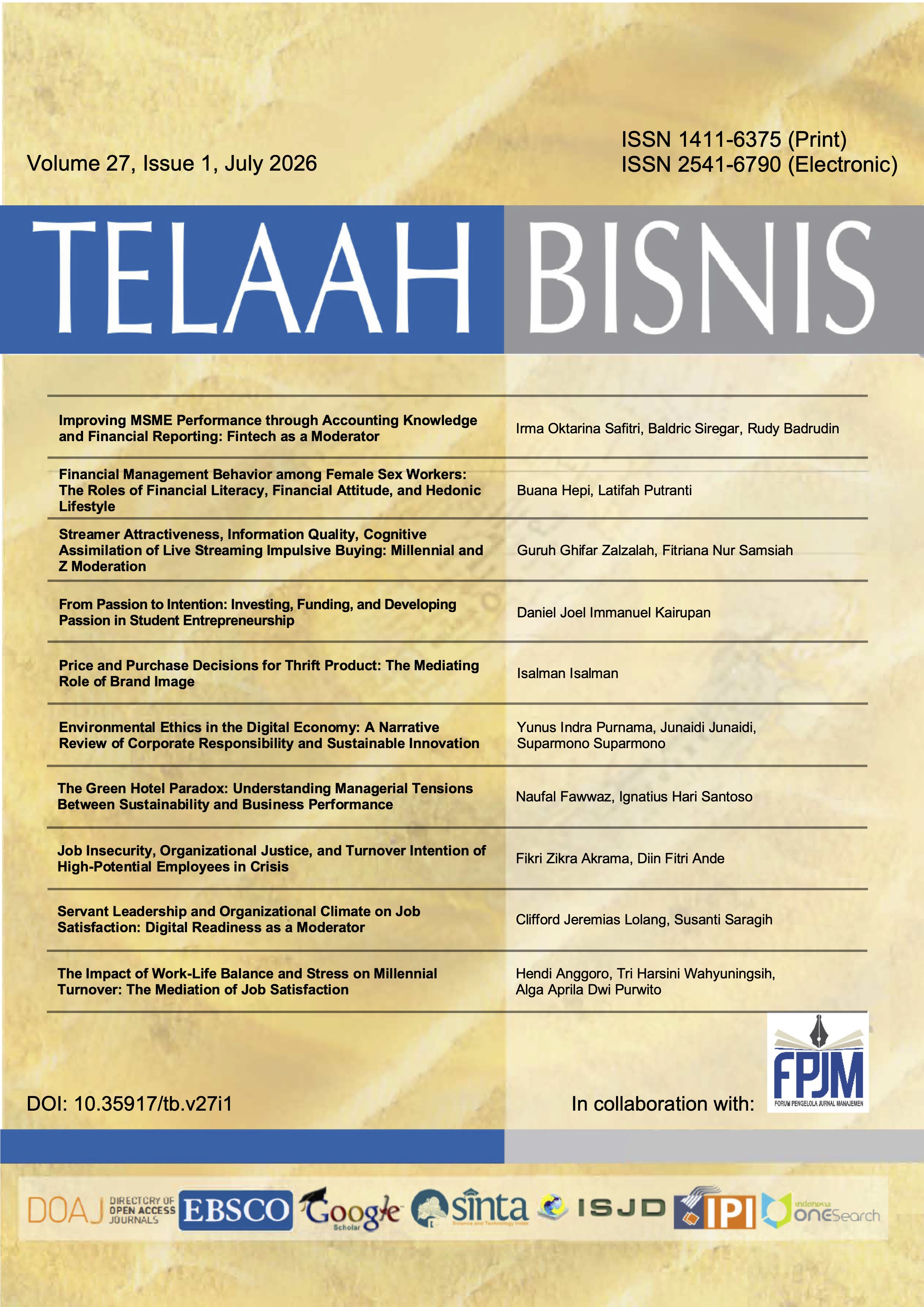
Environmental Ethics in the Digital Economy: A Narrative Review of Corporate Responsibility and Sustainable Innovation
DOI:
https://doi.org/10.35917/tb.v27i1.686Keywords:
ethics, digital transformation, corporate responsibility, sustainable innovation, environmental governance, digital sustainabilityAbstract
The rapid growth of the digital economy has reshaped business models, production systems, and consumption patterns globally. Although digital technologies enhance efficiency and innovation, they also generate environmental challenges such as rising energy consumption, electronic waste, and the ecological impact of digital infrastructure. These issues have increased academic and policy focus on environmental ethics in contemporary business practices. This study aims to review and synthesize the literature on environmental ethics in the digital economy, with a focus on corporate responsibility and sustainable innovation. A narrative literature review method is applied, in which relevant peer-reviewed articles published between 2010 and 2024 were retrieved from Scopus using targeted keyword combinations, screened for relevance through title, abstract, and full-text review, and thematically synthesized to identify recurring conceptual patterns. The findings reveal four interrelated themes, synthesized in a thematic matrix. First, environmental ethics in business supplies the normative foundation for corporate environmental decision-making. Second, corporate environmental responsibility has become a key element of ethical governance in digital business contexts. Third, sustainable innovation and green technologies play a significant role in mitigating environmental impacts of digital transformation. Fourth, the integration of digital transformation and environmental sustainability shows that digital infrastructure itself generates environmental costs, such as rising energy consumption and e-waste, that require deliberate governance. Across these four themes, environmental ethics is increasingly embedded in corporate strategies, governance frameworks, and sustainability-driven business models, and an emerging fifth cluster on digital and artificial-intelligence ethics in ESG governance is identified as a direction for future research. This review strengthens the conceptual understanding of the relationship between environmental ethics, digital transformation, and sustainable innovation. The results underline the importance of aligning technological advancement with environmental responsibility. The study also provides implications for business leaders, policymakers, and researchers in promoting ethical and sustainable practices within the evolving digital economy.
Downloads
References
Aftab, J., Abid, N., Sarwar, H., & Veneziani, M. (2022). Environmental ethics, green innovation, and sustainable performance: Exploring the role of environmental leadership and environmental strategy. Journal of Cleaner Production, 378, 134639. https://doi.org/10.1016/j.jclepro.2022.134639
Aftab, J., Abid, N., Cucari, N., & Savastano, M. (2023). Green human resource management and environmental performance: The role of green innovation and environmental strategy in a developing country. Business Strategy and the Environment, 32(4), 1782–1798. https://doi.org/10.1002/bse.3219
Alshdaifat, S. M., Ab Aziz, N. H., Alhasnawi, M. Y., Alharasis, E. E., Al Qadi, F., & Al Amosh, H. (2024). The role of digital technologies in corporate sustainability: A bibliometric review and future research agenda. Journal of Risk and Financial Management, 17(11), 509. https://doi.org/10.3390/jrfm17110509
Bansal, P., & Song, H.-C. (2017). Similar But Not the Same: Differentiating Corporate Sustainability from Corporate Responsibility. Academy of Management Annals, 11(1), 105–149. https://doi.org/10.5465/annals.2015.0095
Belkhir, L., & Elmeligi, A. (2018). Assessing ICT global emissions footprint: Trends to 2040 & recommendations. Journal of Cleaner Production, 177, 448–463. https://doi.org/10.1016/j.jclepro.2017.12.239
Böhmecke-Schwafert, M., Wehinger, M., & Teigland, R. (2022). Blockchain for the circular economy: Theorizing blockchain's role in the transition to a circular economy through an empirical investigation. Business Strategy and the Environment, 31(8), 3786–3801. https://doi.org/10.1002/bse.3032
Boons, F., & Lüdeke-Freund, F. (2013). Business models for sustainable innovation: state-of-the-art and steps towards a research agenda. Journal of Cleaner Production, 45, 9–19. https://doi.org/10.1016/j.jclepro.2012.07.007
Cao, B., Wang, T., Li, A., Shang, Y., & Zhu, J. (2025). Unveiling the social and environmental benefits of digital transformation in corporations. PLOS ONE, 20(3), e0320064. https://doi.org/10.1371/journal.pone.0320064
Carroll, A. B. (2016). Carroll’s pyramid of CSR: taking another look. International Journal of Corporate Social Responsibility, 1(1). https://doi.org/10.1186/s40991-016-0004-6
Chen, Y.-S. (2008). The Driver of Green Innovation and Green Image – Green Core Competence. Journal of Business Ethics, 81(3), 531–543. https://doi.org/10.1007/s10551-007-9522-1
Cheng, C., & Zhang, M. (2023). Conceptualizing corporate digital responsibility: A digital technology development perspective. Sustainability, 15(3), 2319. https://doi.org/10.3390/su15032319
Covucci, C., Confetto, M. G., Ključnikov, A., & Panait, M. (2024). Unrevealing the nexus between digital sustainability and corporate digital responsibility: A dual-track systematic literature review towards a framework of corporate digital sustainability. Technology in Society, 79, 102743. https://doi.org/10.1016/j.techsoc.2024.102743
Dangelico, R. M., & Pujari, D. (2010). Mainstreaming green product innovation: Why and how companies integrate environmental sustainability. Journal of Business Ethics, 95(3), 471–486. https://doi.org/10.1007/s10551-010-0434-0
Donaldson, T., & Preston, L. E. (1995). The Stakeholder Theory of the Corporation: Concepts, Evidence, and Implications. Academy of Management Review, 20(1), 65–91. https://doi.org/10.5465/amr.1995.9503271992
Eccles, R. G., Ioannou, I., & Serafeim, G. (2014). The Impact of Corporate Sustainability on Organizational Processes and Performance. Management Science, 60(11), 2835–2857. https://doi.org/10.1287/mnsc.2014.1984
Elkington, J. (1998). Partnerships from cannibals with forks: The triple bottom line of 21st‐century business. Environmental Quality Management, 8(1), 37–51. https://doi.org/10.1002/tqem.3310080106
Forti, V., Baldé, C. P., Kuehr, R., & Bel, G. (2020). The global e-waste monitor 2020. https://ewastemonitor.info/wp-content/uploads/2020/11/GEM_2020_def_july1_low.pdf
Freitag, C., Berners-Lee, M., Widdicks, K., Knowles, B., Blair, G. S., & Friday, A. (2021). The real climate and transformative impact of ICT: A critique of estimates, trends, and regulations. Patterns, 2(9), 100340. https://doi.org/10.1016/j.patter.2021.100340
Freudenreich, B., Lüdeke-Freund, F., & Schaltegger, S. (2020). A stakeholder theory perspective on business models: Value creation for sustainability. Journal of Business Ethics, 166(1), 3–18. https://doi.org/10.1007/s10551-019-04112-z
Friede, G., Busch, T., & Bassen, A. (2015). ESG and financial performance: aggregated evidence from more than 2000 empirical studies. Journal of Sustainable Finance and Investment, 5(4), 210–233. https://doi.org/10.1080/20430795.2015.1118917
Geissdoerfer, M., Savaget, P., Bocken, N. M. P., & Hultink, E. J. (2017). The Circular Economy – A new sustainability paradigm? In Journal of Cleaner Production (Vol. 143, pp. 757–768). Elsevier Ltd. https://doi.org/10.1016/j.jclepro.2016.12.048
George, G., Merrill, R. K., & Schillebeeckx, S. J. D. (2021). Digital Sustainability and Entrepreneurship: How Digital Innovations Are Helping Tackle Climate Change and Sustainable Development. Entrepreneurship Theory and Practice, 45(5), 999–1027. https://doi.org/10.1177/1042258719899425
Guo, L., & Xu, L. (2021). The effects of digital transformation on firm performance: Evidence from China's manufacturing sector. Sustainability, 13(22), 12844. https://doi.org/10.3390/su132212844
Jones, N. (2018). How to stop data centres from gobbling up the world’s electricity. Nature, 561(7722), 163–166. https://doi.org/10.1038/d41586-018-06610-y
Lin, T. (2024). Environment, Social, and Governance (ESG) and Artificial Intelligence (AI) in Finance: State-of-the-art and Takeaways. Artificial Intelligence Review, 57, Article 76. https://doi.org/10.1007/s10462-024-10708-3
Lobschat, L., Mueller, B., Eggers, F., Brandimarte, L., Diefenbach, S., Kroschke, M., & Wirtz, J. (2021). Corporate digital responsibility. Journal of Business Research, 122, 875–888. https://doi.org/10.1016/j.jbusres.2019.10.006
Lu, Y., Xu, C., Zhu, B., & Sun, Y. (2024). Digitalization transformation and ESG performance: Evidence from China. Business Strategy and the Environment, 33(2), 352–368. https://doi.org/10.1002/bse.3494
Pan, W., Xie, T., Wang, Z., & Ma, L. (2022). Digital economy: An innovation driver for total factor productivity. Journal of Business Research, 139, 303–311. https://doi.org/10.1016/j.jbusres.2021.09.061
Porter, M. E., & Kramer, M. R. (2011). The Big Idea: Creating Shared Value. Harvard Business Review, 89(1–2), 62–77. https://hbr.org/2011/01/the-big-idea-creating-shared-value
Rehman, S. U., Kraus, S., Shah, S. A., Khanin, D., & Mahto, R. V. (2021). Analyzing the relationship between green innovation and environmental performance in large manufacturing firms. Technological Forecasting and Social Change, 163, 120481. https://doi.org/10.1016/j.techfore.2020.120481
Snyder, H. (2019). Literature review as a research methodology: An overview and guidelines. Journal of Business Research, 104, 333–339. https://doi.org/10.1016/j.jbusres.2019.07.039
Torraco, R. J. (2016). Writing Integrative Literature Reviews. Human Resource Development Review, 15(4), 404–428. https://doi.org/10.1177/1534484316671606
Wang, S., & Esperança, J. P. (2023). Can digital transformation improve market and ESG performance? Evidence from Chinese SMEs. Journal of Cleaner Production, 419, 137980. https://doi.org/10.1016/j.jclepro.2023.137980
Webster, J., & Watson, R. T. (2002). Analyzing The Past To Prepare For The Future: Writing A Literature Review. In MIS Quarterly (Vol. 26, Number 2). http://www.misq.org/misreview/announce.html
Wu, S., & Li, Y. (2023). A study on the impact of digital transformation on corporate ESG performance: The mediating role of green innovation. Sustainability, 15(8), 6568. https://doi.org/10.3390/su15086568
Zhang, H. (2026). Bridging digital responsibility and sustainable development: How corporate AI ethics and international innovation drive ESG performance. Corporate Social Responsibility and Environmental Management, 1–23. https://doi.org/10.1002/csr.70570
Downloads
Published
How to Cite
Issue
Section
Citation Check
License
Copyright (c) 2026 Yunus Indra Purnama, Junaidi Junaidi, Suparmono Suparmono

This work is licensed under a Creative Commons Attribution 4.0 International License.

This work is licensed under a Creative Commons Attribution 4.0 International License.
Authors who publish with this journal agree to the following terms:
- Authors retain copyright and grant the journal right of first publication with the work simultaneously licensed under a Creative Commons Attribution 4.0 International License that allows others to share the work with an acknowledgement of the work's authorship and initial publication in this journal.
- Authors are able to enter into separate, additional contractual arrangements for the non-exclusive distribution of the journal's published version of the work (e.g., post it to an institutional repository or publish it in a book), with an acknowledgement of its initial publication in this journal.
- Authors are permitted and encouraged to post their work online (e.g., in institutional repositories or on their website) prior to and during the submission process, as it can lead to productive exchanges, as well as earlier and greater citation of published work (See The Effect of Open Access).