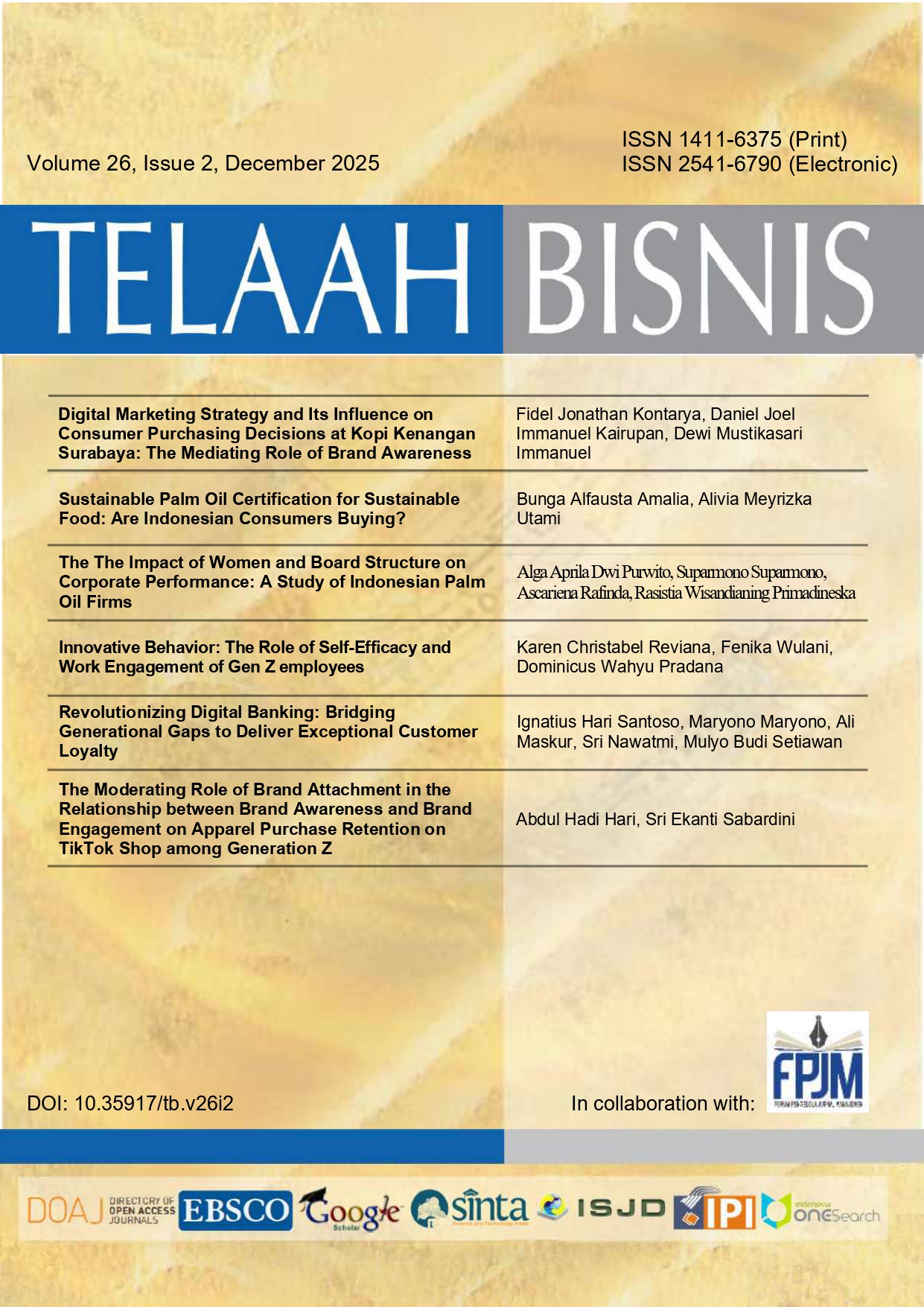
Revolutionizing Digital Banking: Bridging Generational Gaps to Deliver Exceptional Customer Loyalty
DOI:
https://doi.org/10.35917/tb.v26i2.628Keywords:
digital banking, online customer experience, omnichannel integration, generational cohort, customer retentionAbstract
This study investigate how omnichannel integration quality comprised of channel consistency, channel transparency and channel connectivity shape the online customer experience and its subsequent influence the willingness to stay in digital banking. Drawing upon the Stimulus – Organism – Response framework, the research also examined whether the generational cohorts moderate these relationship. A quantitative method with purposive sampling is employed, involving 90 valid response from Indonesian digital banking users, belonging to Generation Y and Z. Structural equation modelling using Smart PLS is applied to assess. The findings reveal that channel connectivity does not exert a meaningful effect. Furthermore, online customer experience strongly predicts the customers’ willingness to stay. These result suggest that consistency and transparency remain critical lever for optimizing digital experiences, while connectivity has become baseline expectation rather than a differentiating factor. This research extends the online customer experience and omnichannel literature by highlighting generational convergence in digital expectation. Practically it advises banks to prioritize the seamless, transparent and consistent service delivery to strengthen customer retention.
Downloads
References
Addae, J.A., Boakye, K.G., Ampong, G.O.A., Anyigba, H., Majeed, M., Abubakari, A., & Ofori, K.S. (2024). The Interplay between Multichannel Integration Quality, Service Convenience, Service Experience, Multichannel Perceived Value and e-WOM. International Journal of Quality and Reliability Management, 42(4), 1110-1131, https://doi.org/10.1108/ijqrm-08-2023-0264
Andriani, A., Setyorini, H., & Shibghatalloh, F. (2025). Investigating e-servicescape influence to customer response in digital Islamic banking. International Journal of Islamic Economics and Finance, 4(1), 101-120, https://doi.org/10.18196/ijief.v4i1.10299
Armelia, P.A., & Wahyuni, M.A. (2020). Pengaruh Kompetensi Aparatur Desa, Efektivitas Pengendalian Internal dan Moral Sensitivity terhadap Pencegahan Fraud dalam Pengelolaan Keuangan Desa. Vokasi: Jurnal Riset Akuntansi, 9(2), 61-70, https://doi.org/10.23887/vjra.v9i2.26125
Athaide, G.A., Zhang, J.Q., & Klink, R.R. (2024). Customer Experience Management (CXM) and New Product Success: an Empirical Investigation. European Journal of Innovation Management, https://doi.org/10.1108/EJIM-11-2023-1033
Baabdulah, A.M., Alalwan, A.A., Rana, S., & Taghizadeh, H. (2021). The Prerequisite and Consequences of Customers’ Online Experience Regarding the Moderating Role of Brand Congruity : Evidence from Iranian Bank. Journal of Islamic Marketing, 13(10), 2144-2172, https://doi.org/10.1108/JIMA-09-2020-0277
Bag, S., Gupta, S., Kumar, A., & Sivarajah, U. (2021). An Integrated Artificial Intelligence Framework for Knowledge Creation and B2B Marketing Rational Decision Making for Improving Firm Performance. Industrial Marketing Management, 92, 178-189, https://doi.org/10.1016/j.indmarman.2020.12.001
Barile, D., Secundo, G., & Del Vecchio, P. (2025). Discovering the Phygital Customer Experience: Which Digital Technologies Influence Leading Companies’ Process? European Journal of Innovation Management, 1-26, https://doi-org.proxy.undip.ac.id/10.1108/EJIM-08-2024-0887
Bartoli, A., Cappa, F., & Oriani, R. (2023). Generational differences in digital behavior:
a systematic literature review. Journal of Infrastructure, Policy and Development, 8(9), 6755, https://doi.org/10.24294/jipd.v8i9.6755
Barquin, S., de Gantes, G., Vinayak, H.V., & Shrikhande, D. (2019, february).
Digital banking in Indonesia: Building Loyalty and generating grwoth. Jakarta: McKinsey & Company, https://www.mckinsey.com/industries/financial-services/our-insights/digital-banking-in-indonesia-building-loyalty-and-generating-growth
Batat, W., & Hammedi, W. (2023). The Extended Reality Technology (ERT) Framework for Designing Customer and Service Experiences in Phygital Settings: a Service Research Agenda. Journal of Service Management, 34(1), 10-33, https://doi.org/10.1108/JOSM-08-2022-0289
Brosius, A., Ohme, J., & de Vreese, C.H. (2022). Generational Gaps in Media Trust and Its Antecedents in Europe. The International Journal of Press/Politics, 27(1), 226-247, https://doi.org/10.1177/19401612211039440
Cao, L., & Li, L. (2015). The Impact of Cross-Channel Integration on Retailers’ Sales Growth. Journal of Retailing, 91(2), 198-216,
https://doi.org/10.1016/j.jretai.2014.12.005
Choudhury, K., Singh, N., & Mishra, B.B. (2019). Service Quality and Customer Loyalty in e-Commerce: a Study of Online Banking in India. Journal of Asia Business Studies, 13(1), 1-24, https://doi.org/10.1108/JABS-02-2017-0027
Chung, S., Kramer, T., & Wong, E.M. (2018). Do Touch Interface Users Feel More Engaged? The Impact of Input Device Type on Online Shoppers Engagement, Affect, and Purchase Decision. Psychology and Marketing, 35(11), 795-806, https://doi.org/10.1002/mar.21135
Cocco, H., & Demoulin, N.T.M. (2022). Designing a Seamless Shopping Journey through Omnichannel Retailer Integration. Journal of Business Research, 150, 461-475, https://doi.org/10.1016/j.jbusres.2022.06.031
Djafarova, E., & Bowes, T. (2021). Instagram Made Me Buy It: Generation Z Impulse
Purchase in Fashion Industry. Journal of Retailing and Consumer Services, 59(1), 102345, https://doi.org/10.1016/j.jretconser.2020.102345
Dorie, J., & Loranger, D. (2020). The Multi-generation: Generational Differences in
Channel Activity. International Journal of Retail & Distribution Management, 48(9), 1005-1022, https://doi.org/10.1108/IJRDM-06-2019-0196
Frasquet, M., Miguel, M.J., & Molla, A. (2015). Do channel integration efforts pay off in terms of online and offline customer loyalty? International Journal of Retail and Distribution Management, 43(7), 589-609, https://doi.org/10.1108/IJRDM-07-2014-0092
Gao, L., & Su, Y. (2017). Online Channel Integration and Consumers’ Channel Choice Behavior: a Transaction Cost Perspective. INdustrial Management & Data System, 117(9), 2077-2094,
https://doi.org/10.1108/IMDS-02-2016-0052citeturn17search86
Gao, M., & Huang, L. (2021). Quality of channel integration and customer loyalty in omnichannel retailing: the Mediating role of customer engagement and relationship program receptiveness. Journal of Retailing and Consumer Services, 63, 102688, https://doi.org/10.1016/j.jretconser.2021.102688
Gao, P., Waechter, K.A., & Bai, X. (2015). Understanding Consumers’ Continuance Intention toward Mobile Purchase: a Theoretical Framework and Empirical Study: a Case of Chine. Computers in Human Behavior, 53, 249-262, https://doi.org/10.1016/j.chb.2015.07.014
Gao, W., Fan, H., Li, W., & Wang, H. (2021). Crafting the customer experience in omnichannel context: the Role of channel integration. Journal of Business Research, 126, 12-22, https://doi.org/10.1016/j.jbusres.2020.12.056
Hair, J.F., Babin, B.J., Anderson, R.E., Black, W.C. (2019). Multivariate data analysis, 8th edition. Hampshire, UK: Cengage Learning.
Herhausen, D., Binder, J., Schoegel, M., & Herrmann, A. (2015). Integrating Bricks with Clicks: Retailer-level and Channel-level Outcomes of Online-offline Channel Integration. Journal of Retailing, 91(2), 309-325, https://doi.org/10.1016/j.jretai.2014.12.009
Illahi, S.K., Taufiq, M., Wardaya, W. (2025). The Impact of Infrastructure Access and Information Technology Use on Open unemployment Rate in Java. Asian Journal of Applied Business and Management, 4(3), 1033-1046, https://doi.org/10.55927/ajabm.v4i3.423
Ilmudeen, A., & Bao, Y. (2019). What Obstructs Customer Acceptance of Internet Banking? Security and Privacy, Risk, Trust, and Website Usability and the Role of Moderators. The Journal of Hight Technology Management Research, 29(1), 109-123, https://doi.org/10.1016/j.hitech.2018.04.010
Jones, A., White, E., Brown, J., & Taylor, L. (2020). Differential Evaluation of Chatbot-led Interaction: a Comparative Analysis. Journal of Business Research, 45(1), 87-102
Juaneda-Ayensa, E., Mosquera, A., & Murillo, S.Y., (2016). Omnichannel Customer Behavior: Key Drivers of Technology Acceptance and Use and Their Effects on Purchase Intention. Frontiers in Psychology,7, 1117, https://doi.org/10.3389/fpsyg.2016.01117
Kalubangga, M., Kakwezi, P., & Kaiize, D. (2013). The Effect of Fraudulent Procurement Practice on Public Procurement Performance. International Journal of Business and Behavioral Science, 3.
Katadata. (2020, March 5). EV-DCI: Menilik Daya Saing Digital Daerah di Indonesia. Katadata.co.id. https://katadata.co.id/analisisdata/5e9a57af903e0/ev-dci-menilik-daya-saing-digital-daerah-di-indonesia?
Kim, L., Jindabot, T., & Yeo, S.F. (2024). Understanding Customer Loyalty in Banking Industry: A Systematic Review and Meta-analysis.Heliyon, 10(1) e36619, https://doi.org/10.1016/j.heliyon.2024.e36619
Klaus, P., Maklan, S. (2012). Towards a Better Measure of Customer Experience. International Journal of Market Research, 5496), 771-792, https://doi.org/10.2501/IJMR-2013-021
Klaus, P. (2013). The Case of Amazon.com: Toward a Conceptual Framework of Online Customer Service Experience Using the Emerging Consensus Technique. Journal of Service Marketing, 27(6), 443-457, https://doi.org/10.1108/JSM-02-2012-0030
Lazaridis, C., Sarantopoulos, P., Vrechopoulos, A., & Doukidis, G. (2021). Effects of Increased Omnichannel Integration on Customer Satisfaction and Loyalty Intention. International Journal of Electronic Commerce, 25(4), 440-468, https://doi.org/10.1080/10864415.2021.1967005
Lee, Z.W.Y., Chan, T.K.H., Chong, A.Y.L., & Thadani, D.R. (2019). Customer
Engagement through Omnichannel Retailing: The Effects of Channel Integration Quality. Industry Marketing Management, 77, 90-101, https://doi.org/10.1016/j.indmarman.2018.12.004
Lin, X., Wang, X., & Hajli, N. (2019). Building e-Commerce Satisfaction and Boosting
Sales:The Role of Social Commerce Trust and Its Antecedents. International Journal of Electronic Commece, 23(3), 328-363, https://doi.org/10.1080/10864415.2019.1619907
Mahfuzh, M.A., Setyono, J., & Riza, A.F. (2025). Examining the model for enhancing e-loyalty in digital banks. Signifikan: Jurnal Ilmu Ekonomi, 14(1), 247 – 264, https://doi.org/10.15408/sjie.v14i1.44901
Mainardes, E., W., de Moura Rosa, C.A. & Nossa, S.N. (2020). Omnichannel strategy and customer loyalty in banking. International Journal of Bank Marketing, 38(4), 799 – 820, https://doi.org/10.1108/IJBM-04-2019-0151
Oh, L., B., Teo, H.H., & Sambamurthy, V. (2012). The Effect of Retail Channel Integration through The Use of Information Technologies on Firm Performance. Journal of Operations Management, 30(5), 368-381, https://doi.org/10.1016/j.jom.2012.03.001
Ozkan, P., Suer, S., Keser, I.K. & Kocakoc, I.D. (2019). The Effect of Service Quality and Customer Satisfaction on Customer Loyalty: The Mediation of Perceived Value of Service, Corporate Image, and Corporate Reputation. International Journal of Bank Marketing,
https://doi.org/10.1108/IJBM-03-2019-0096
Prassida, G.F., & Hsu, P.Y. (2022). The Harmonious Role of Channel Integration and Logistics Service in Omnichannel Retailing: the Case of IKEA. Journal of Retailing and Consumer Services, 68, 103030, https://doi.org/10.1016/j.jretconser.2022.103030
Priporas, C.V., Stylos, N., & Fotiadis, A.K. (2017. Generation Z Consumers’ Expectation of Interaction in Smart Retailing: a Future Agenda. Computers in Human Behavior, 77(1), 374-381, https://doi.org/10.1016/j.chb.2017.01.058
Putra, F.H., Suhardjanto, D., Trinugroho, I., & Arifin, T. (2024). Overcoming Barrier to Inclusion: The Role of Financial Literacy and Digital Divide in Expanding Financial Access in Indonesia. Journal of Ecohumanism, 3(8), 9956-9966, https://doi.org/10.62754/joe.v3i8.5608
Putri, C.D.P., & Santoso, I.H. (2022). Implementation of Klaus's Customer Experience Quality Concept on Intention to Switch Nexa Internet Customers to Other Internet Provider. Jurnal Ekonomi, 12(04), 230-239.
Quality Concept on Intention to Switch Nexa’s Internet Customer to Other Internet Provider. Jurnal Ekonomi, 12(4), 230-239
Radomska, J., Kawa, A., Hajdas, M., Klimas, P., & Silva, S. C. (2025). Unveiling retail omnichannel challenges: developing an omnichannel obstacles scale. International Journal of Retail & Distribution Management, 53(13), 1-20.
Omnichannel Challenges: Developing an Omnichannel Obstacles Scale. Internatinal Journal of Retail and Distribution Management, 53(13), 1-20, https://doi.org/10.1108/IJRDM-04-2024-0169
Rahman, S.M., Carlson, J., Gudergan, S.P., & Wetzels, M. (2025). How do omnichannel
customer experiences afffect customer engagement? Theory and empirical validation. Journal of Business Research, 150, 115196, https://doi.org/10.1016/j.jbusres.2025.115196
Rather, R.A., & Islam, J.U. (2022). Customer Experience and Engagement in Service
Marketing: an Empirical Study of the Antecedents and Consequences. Journal of Retailing and Consumer Services, 65(1), 102867,
https://doi.org/10.1016/j.jretconser.2021.102867
Santoso, I.H., Nurcholis, L., & Kartika, E. (2020). Intention to Use Mobile Banking Application: Gender Based. Jurnal Penelitian Ekonomi dan Bisnis, 5(2), 203-211, https://doi.org/10.33633/jpeb.v5i2.3126
Seth, T., Keshari, N., Chowdhury, S., Nath Jha, S. (2025). Evaluating customer satisfaction through omnichannel banking integration quality: a Moderated mediation mechanism. Academy of Marketing Studies Journal, 29(4), 1-16
Shankar, A., & Jebarajakirthy, C. (2019). The Influence of e-Banking Service Quality on Customer Loyalty: A Moderated Mediation Approach. International Journal of Bank Marketing, 37(5), 1119-1142, https://doi.org/10.1108/IJBM-03-2018-0063
Solem, B.A.A., Frederisksen, J.I., & Sorebo, O. (2023). Dynamic Capabilites in The Realisation of Omnichannel Retailing. International Journal of Retail and Distribution Management, 51(1), 21-38, https://doi.org/10.1108/IJRDM-12-2021-0599
Sousa, R., & Voss, C.A. (2016). Service Quality in Multichannel Services Employing Virtual Channels. Journal of Service Management, 27(4), 460-478.
Sujana, E., Yasa, I.N.P., & Wahyuni, M.A. (2018). Testing of Fraud Diamond Theory based on Local Wisdom on Fraud Behavior. Advanced in Economics, Business, and Management Research, 69, 12-15.
Thasleena, K.F., & Shanti, P. (2025). Generational Divide in Digital Banking: Comparing Experience and Expectation Across Generation X, Y, and Z. Indian Journal of Information Sources and Services, 15(2), 268-274, https://doi.org/10.51983/ijiss-2025.IJISS.15.2.34
Verhoef, P.C., Broekhuizen, T., Bart, Y., Bhattacharya, A., Dong, J.Q., Fabian, N., & Haenlein, M. (2021). Digital Transformation: A Multidisciplinary Reflection and Research Agenda. Journal of Business Research, 122, 889-901.
Verhoef, P.C., Kannan, P.K., & Inman, J.J. (2015). From multi channel retailing to omni-channel retailing: Introduction to the special issue on multi channel retailing. Journal of Retailing, 91(2), 174-181, https://doi.org/10.1016/j.jretai.2015.02.005
Wu, L.W., Wu, Y.H., Tang, Y.C., & Wang, C.Y. (2025). Strenghtening Journey Satisfaction trough Effective Customer Journey Design for Omnichannel Retailing. International Journal of Retail & Distribution Management, 1,7 https://doi-org.proxy.undip.ac.id/10.1108/IJRDM-08-2024-0405
Xuan, Q.T., Truong, H.T.H., & Vo, T.Q. (2023). The impacts of omnichannel retailing properties on customer experince and brand loyalty: a Study in the banking sector. Cogent Business & Management, 10(2), 2244765, https://doi.org/10.1080/23311975.2023.2244765
Yue, P., Korkmaz, A.G., Yin, Z., & Zhou, H. (2022). The Rise of Digital Finance: Financial Inclusion or Debt Trap. Finance Research Letter, 46, 102477
Zhang, M., Zhu, C., & Ye, Y. (2020). The Effect of Cross-channel Integration on Customer Loyalty in Omnichannel Retailing: The Mediating Role of Customer Engagement. Journal of Retailing and Consumer Services, 55, 102-113.
Zhang, Y., & Nie, H. (2022). Older Adults’ Adoption of Mobile Banking in China: A Qualitative Study. Frontiers in Psychology, 13, 918057
Downloads
Published
How to Cite
Issue
Section
Citation Check
License
Copyright (c) 2025 Ignatius Hari Santoso, Maryono Maryono, Ali Maskur, Sri Nawatmi, Mulyo Budi Setiawan

This work is licensed under a Creative Commons Attribution 4.0 International License.

This work is licensed under a Creative Commons Attribution 4.0 International License.
Authors who publish with this journal agree to the following terms:
- Authors retain copyright and grant the journal right of first publication with the work simultaneously licensed under a Creative Commons Attribution 4.0 International License that allows others to share the work with an acknowledgement of the work's authorship and initial publication in this journal.
- Authors are able to enter into separate, additional contractual arrangements for the non-exclusive distribution of the journal's published version of the work (e.g., post it to an institutional repository or publish it in a book), with an acknowledgement of its initial publication in this journal.
- Authors are permitted and encouraged to post their work online (e.g., in institutional repositories or on their website) prior to and during the submission process, as it can lead to productive exchanges, as well as earlier and greater citation of published work (See The Effect of Open Access).