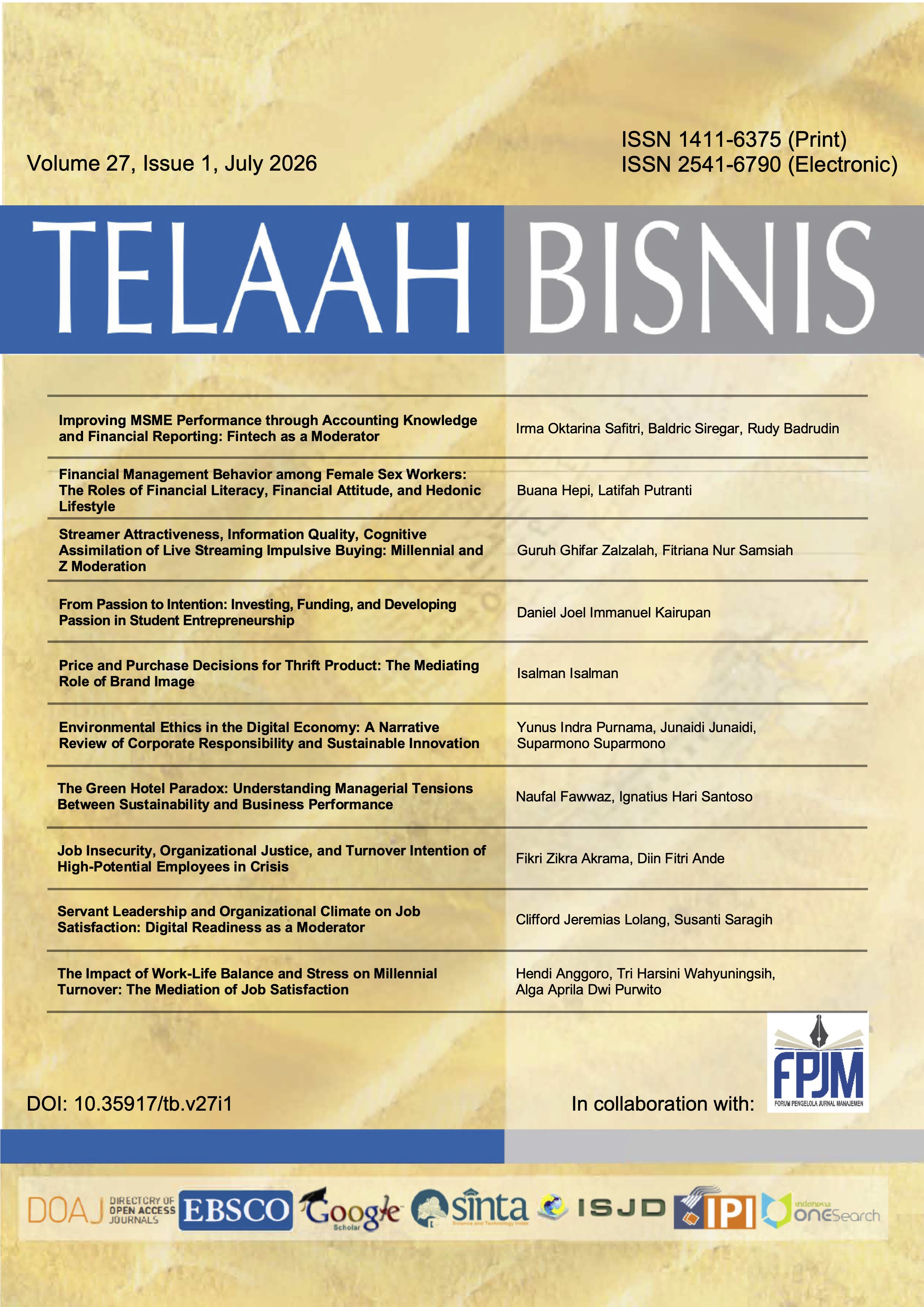
Job Insecurity, Organizational Justice, and Turnover Intention of High-Potential Employees in Crisis
DOI:
https://doi.org/10.35917/tb.v27i1.708Keywords:
SDGs 8, High Potential Employees, Job Insecurity, Organizational Justice, Turnover Intention, Organizational CommitmentAbstract
The construction industry is particularly susceptible to economic fluctuations, frequently resulting in restructuring and heightened stress for high-potential employees (HiPo). This study examines the influence of job insecurity and organizational justice on turnover intention, with organizational commitment serving as a mediating variable, focusing on HiPo employees at PT ZX, a state-owned construction company experiencing a crisis. Employing a quantitative approach with 234 respondents, data were analyzed using Partial Least Squares Structural Equation Modeling (PLS-SEM). The research draws upon Conservation of Resources (COR) Theory and Social Exchange Theory, testing seven hypotheses regarding both direct and indirect effects. Results indicate that job insecurity has a significant positive effect on turnover intention and a significant negative effect on organizational commitment, whereas organizational justice has no significant direct effect on turnover intention but strongly strengthens organizational commitment. Organizational commitment, in turn, significantly reduces turnover intention and significantly mediates the effects of both job insecurity and organizational justice on turnover intention. These findings contribute to the literature on talent retention and provide practical recommendations for human resource management during crises. The study integrates job insecurity and organizational justice as predictors within a mediation model tailored to the construction sector crisis. Practically, it proposes strategies for BUMN HRM to develop equitable and sustainable talent-retention policies. The evidence further supports SDG 8 (Decent Work and Economic Growth), particularly Targets 8.5 and 8.8, by demonstrating the significance of organizational justice and commitment in sustaining decent work during restructuring in the construction sector.
Downloads
References
Anand, A., Dalmasso, A., Vessal, S. R., Parameswar, N., Rajasekar, J., & Dhal, M. (2023). The effect of job security, insecurity, and burnout on employee organizational commitment. Journal of Business Research, 162. https://doi.org/10.1016/j.jbusres.2023.113843
Ashfaq, A., Hayat, K., & Aziz, A. (2023). The Impact of Job Embeddedness, Job Insecurity, and Job Autonomy on Turnover Intention: Organizational Commitment as The Mediating Effect. Journal for Business Education and Management, 3(2), 157–176. https://doi.org/10.56596/jbem.v3i2.82
Azmy, A., & Mauludi, S. (2024). The Role of Authentic Leadership and Organizational Commitment to Reduce Turnover Intention in Digital Company. Binus Business Review, 15(2), 119–131. https://doi.org/10.21512/bbr.v15i2.10502
Bakri, N., & Ali, N. (2015). The impact of organizational justice on turnover intention of Bankers of KPK, Pakistan: The mediator role of organizational commitment. Asian Social Science, 11(21), 143–147. https://doi.org/10.5539/ass.v11n21p143
Bhaskoro, H., Noermijati, & Suryadi, N. (2024). The effect of organizational justice and workload on turnover intention with job stress as a mediating variable. Journal of Management, Economic and Financial, 2(1).
Blau, P. M. (1964). Justice in social exchange. Sociological Inquiry, 34(2). https://doi.org/10.1111/j.1475-682X.1964.tb00583.x
Blau, P. M., Wiley, J., York, N., London, •, & Sydney, •. (1964). Exchange and power in social life.
Bothma, C. F. C., & Roodt, G. (2013). The validation of the turnover intention scale. SA Journal of Human Resource Management, 11(1). https://doi.org/10.4102/sajhrm.v11i1.507
Brewster, C., & Brookes, M. (2024). Sustainable development goals and new approaches to HRM: Why HRM specialists will not reach the sustainable development goals and why it matters. German Journal of Human Resource Management, 38(2), 183–201. https://doi.org/10.1177/23970022241229037
Colquitt, J. A. (2001). On the dimensionality of organizational justice: A construct validation of a measure. Journal of Applied Psychology, 86(3), 386–400. https://doi.org/10.1037/0021-9010.86.3.386
Cropanzano, R., & Mitchell, M. S. (2005). Social exchange theory: An Interdisciplinary review. Journal of Management, 31(6). https://doi.org/10.1177/0149206305279602
Cropanzano, R. S., Ambrose, M. L., Proudfoot, D., & Lind, E. A. (2015). Fairness heuristic theory, the uncertainty management model, and fairness at work. In The Oxford Handbook of Justice in the Workplace. https://doi.org/10.1093/oxfordhb/9780199981410.013.17
Dwiguna, P. M., Sudiarditha, I. K. R., & Yohana, C. (2024). The effect of work stress and job insecurity on turnover intention with organizational commitment as an intervening at PT “Xyz.” International Student Confrence on Business, Education, Economics, Accounting, and Management (ISC-BEAM), 2(1), 2345–2359. https://doi.org/https://doi.org/10.21009/ISC-BEAM.012.169
Fauza, G. R., Malik, N., & Rumijati, A. (2022). The effect of organizational justice on turnover intention mediated by organizational commitment. Jamanika (Jurnal Manajemen Bisnis Dan Kewirausahaan), 2(04), 302–309. https://doi.org/10.22219/jamanika.v2i04.22758
Fitta, R., Dewi, F. I. R., & Idulfilastri, R. M. (2020). The role of job insecurity and organizational commitment to turnover intention on startup employee (Vol. 478). Atlantis Press.
Fornell, C. and Larcker, D. F. (1981). Evaluating structural equation models with unobservable variables and measurement error. Journal of marketing research, 39–50. In American Marketing Association (Vol. 18).
Gim, G. C. W., Desa, N. M., & Ramayah, T. (2015). Competitive Psychological Climate and Turnover Intention with the Mediating Role of Affective Commitment. Procedia - Social and Behavioral Sciences, 172, 658–665. https://doi.org/10.1016/j.sbspro.2015.01.416
Greenberg, J. (1990). Organizational Justice: Yesterday, Today, and Tomorrow. Journal of Management, 16(2), 399–432. https://doi.org/10.1177/014920639001600208
Greenhalgh, L., & Rosenblatt, Z. (1984). Job Insecurity: Toward Conceptual Clarity. Academy of Management Review, 9(3), 438–448. https://doi.org/10.5465/amr.1984.4279673
Güzel, S. Ö., & Ergen, F. D. (2022). Examining the relationship between job Insecurity, organizational commitment and turnover intention in the covid-19 process. Journal of Tourismology, 8(1). https://doi.org/10.26650/jot.2022.8.1.1078475
Hair, J. F., Hult, G. T. M., Ringle, C. M., Sarstedt, M., Danks, N. P., & Ray, S. (2021). Partial Least Squares Structural Equation Modeling (PLS-SEM) Using R. Springer International Publishing. https://doi.org/10.1007/978-3-030-80519-7
Hasyim, A. F., & Palupiningdyah. (2021). Organizational Justice and Organizational Citizenship Behavior: The Mediating Roles of Organizational Commitment and Leader-Member Exchange. Management Analysis Journal. http://maj.unnes.ac.id
Henseler, J., Ringle, C. M., & Sarstedt, M. (2015). A new criterion for assessing discriminant validity in variance-based structural equation modeling. Journal of the Academy of Marketing Science, 43(1). https://doi.org/10.1007/s11747-014-0403-8
Hobfoll, S. E. (1989). Conservation of resources: A new attempt at conceptualizing stress. American Psychologist, 44(3), 513–524. https://doi.org/10.1037/0003-066X.44.3.513
Holmgreen, L., Tirone, V., Gerhart, J., & Hobfoll, S. E. (2017). Conservation of resources theory. In The Handbook of Stress and Health (pp. 443–457). Wiley. https://doi.org/10.1002/9781118993811.ch27
Ike, O. O., Ugwu, L. E., Enwereuzor, I. K., Eze, I. C., Omeje, O., & Okonkwo, E. (2023). Expanded-multidimensional turnover intentions: scale development and validation. BMC Psychology, 11(1). https://doi.org/10.1186/s40359-023-01303-2
Imamoglu, S. Z., Ince, H., Turkcan, H., & Atakay, B. (2019). The Effect of Organizational Justice and Organizational Commitment on Knowledge Sharing and Firm Performance. Procedia Computer Science, 158, 899–906. https://doi.org/10.1016/j.procs.2019.09.129
Isaac, S., & Michael, W. B. (1995). Handbook in research and evaluation: A collection of principles, methods, and strategies useful in the planning, design, and evaluation of studies in education and the behavioral sciences, 3rd ed. EdITS Publishers.
Jang, J., Lee, D. W., & Kwon, G. H. (2021). An analysis of the Influence of organizational justice on organizational commitment. International Journal of Public Administration, 44(2), 146–154. https://doi.org/10.1080/01900692.2019.1672185
Jiang, L., & Lavaysse, L. M. (2018). Cognitive and affective job insecurity: A meta-analysis and a primary study. Journal of Management, 44(6), 2307–2342. https://doi.org/10.1177/0149206318773853
Kee, D. M. H., & Chung, K. S. (2021). Perceived organizational injustice, job satisfaction, organizational commitment, and turnover intention: A study of mncs in malaysia. International Journal of Business and Society, 22(2), 1047–1065. https://doi.org/10.33736/ijbs.3781.2021
Khalilah, F. N., & Amalia, L. (2024). The Influence Of Transformational Leadership, Work Engagement On Turnover Intention With Job Insecurity Mediation In Millennial And Z Generations In East Jakarta Construction Companies. Journal of Social Research, 3. https://doi.org/https://doi.org/10.55324/josr.v3i11.2277
Khurram, S., Khurram, A., Hassan, S., & Fatima, S. (2020). Examining organizational justice, emotional exhaustion and workplace bullying as antecedents of organizational commitment: A developing country’s perspective. Journal of Applied Economics and Business Studies, 4(1), 123–142. https://doi.org/10.34260/jaebs.416
Kim, M. J., & Kim, B. J. (2020). The performance implications of job insecurity: The sequential mediating effect of job stress and organizational commitment, and the buffering role of ethical leadership. International Journal of Environmental Research and Public Health, 17(21). https://doi.org/10.3390/ijerph17217837
Kline, R. B. (2016). Principles and Practice of Structural Equation Modeling (Fourth Edition). The Guilford Press.
Küfeoğlu, S. (2022). SDG-8: Decent Work and Economic Growth (pp. 331–348). https://doi.org/10.1007/978-3-031-07127-0_10
Lee, S. H., & Jeong, D. Y. (2017). Job insecurity and turnover intention: Organizational commitment as mediator. Social Behavior and Personality, 45(4), 529–536. https://doi.org/10.2224/sbp.5865
Loosemore, M., Dainty, A., & Lingard, H. (2003). Human Resource Management in Construction Projects Strategic and operational approaches (First Edition). Spon Press (an imprint of the Taylor & Francis Group).
Makhamara, F. H., & Bula, H. O. (2022). A Critical Review of Green Human Resource Management and Environmental Sustainability in Firms. IOSR Journal of Business and Management, 24(10), 43–51. https://doi.org/10.9790/487X-2410044351
Martins, P., Nascimento, G., & Moreira, A. (2023). Leadership and turnover intentions in a public hospital: The mediating effect of organisational commitment and moderating effect by activity department. Administrative Sciences, 13(1). https://doi.org/10.3390/admsci13010018
Mcdonnell, A., Collings, D. G., Business, W., & Schuler, R. (2017). Talent management: a systematic review and future prospects. European J. International Management, 11(1), 86–128.
Mete, E. S., & Sökmen, A. (2019). The Mediating Role of Organizational Commitment in the Organizational Justice’s Effect on Job Satisfaction and Turnover Intention: A Research on Academic Staff. Gazi Journal of Economics and Business, 5(3), 193–205. https://doi.org/10.30855/gjeb.2019.5.3.005
Meyer, J. P., & Allen, N. J. (1991). A three-component conceptualization of organizational commitment.
Meyer, J. P., Becker, T. E., & Vandenberghe, C. (2004). Employee commitment and motivation: A conceptual analysis and integrative model. Journal of Applied Psychology, 89(6), 991–1007. https://doi.org/10.1037/0021-9010.89.6.991
Mobley, W. H. (1977). Intermediate Linkages in the Relationship Between Job Satisfaction and Employee Turnover. In Journal of Applied Psychology (Vol. 62, Number 2).
Mohyi, A. (2021). The effect of job satisfaction on turnover intention through organizational commitment as a mediation. Asia Pacific Journal of Management and Education, 4(3). https://doi.org/10.32535/apjme.v4i3.1269
Montes, S. D., Rousseau, D. M., & Tomprou, M. (2015). Psychological Contract Theory. In Wiley Encyclopedia of Management (pp. 1–5). Wiley. https://doi.org/10.1002/9781118785317.weom110075
Nugroho, S. H., & Afifah, S. (2021). The Relationship Of Organizational Justice And Job Embeddedness On Turnover Intention With Mediation Of Organizational Commitment. International Journal of Progressive Sciences and Technologies (IJPSAT, 29(1), 335–346. http://ijpsat.ijsht-journals.org
Pratama, E. N., Suwarni, E., & Handayani, M. A. (2022). Effect Of Job Satisfaction And Organizational Commitment On Turnover Intention With Person Organization Fit As Moderator Variable. APTISI Transactions on Management (ATM), 6(1), 74–82. https://doi.org/10.33050/atm.v6i1.1722
Pratiwi, N. made P. G., & Surya, I. B. K. (2025). The Effect of Job Insecurity on Turnover Intention Mediated by Job Satisfaction at PT. Indocitra Jaya Samudera. International Journal of Economics, Management and Accounting, 1–10. https://doi.org/10.61132/ijema.v2i3.664
Preacher, K. J., & Hayes, A. F. (2008). Asymptotic and resampling strategies for assessing and comparing indirect effects in multiple mediator models. Behavior Research Methods, 40(3), 879–891. https://doi.org/10.3758/BRM.40.3.879
Rousseau, D. (2014). Psychological Contracts in Organizations: Understanding Written and Unwritten Agreements. In Psychological Contracts in Organizations: Understanding Written and Unwritten Agreements. SAGE Publications, Inc. https://doi.org/10.4135/9781452231594
Rusbadrol, N., Panatik, S. A., Sarip, A., & Fakhruddin, F. M. (2021). Effects of Organizational Justice and Organizational Citizenship Behavior on Employee Turnover Intention. International Journal of Academic Research in Business and Social Sciences, 11(17). https://doi.org/10.6007/ijarbss/v11-i17/11393
Sari, O. P., Zunaidah, Z., & Andriana, I. (2023). The effect of job insecurity and job stress on turnover intention with job satisfaction as a mediation variable. Devotion : Journal of Research and Community Service, 4(9). https://doi.org/10.59188/devotion.v4i9.551
Sekaran, U., & Bougie, R. (2016). Research Methods for Business A Skill-Building Approach (7th Edition). John Wiley & Sons. http://lccn.loc.gov/2015051045
Serhan, C., Nehmeh, N., & Sioufi, I. (2022). Assessing the effect of organisational commitment on turnover intentions amongst Islamic bank employees. ISRA International Journal of Islamic Finance, 14(2). https://doi.org/10.1108/IJIF-01-2021-0008
Shoss, M. K. (2017). Job Insecurity: An Integrative Review and Agenda for Future Research. Journal of Management, 43(6), 1911–1939. https://doi.org/10.1177/0149206317691574
Silzer, R., & Church, A. H. (2009). The Pearls and Perils of Identifying Potential. Industrial and Organizational Psychology, 2(4), 377–412. https://doi.org/10.1111/j.1754-9434.2009.01163.x
Subiyanto, D., Septyarini, E., & Dinata, O. H. (2022). Tingkat Pengaruh Kepuasan Gaji Dan Kepuasan Kerja Sebagai Mediator Hubungan Antar Keadilan Organisasional Terhadap Niat Untuk Pindah Kerja: Studi Pada Dinas Perindustrian dan Perdagangan Yogyakarta. 4(5), 1253–1269. https://doi.org/10.47476/reslaj.v4i5.1102
Suifan, T. S., Diab, H., & Abdallah, A. B. (2017). Does organizational justice affect turnover-intention in a developing country? The mediating role of job satisfaction and organizational commitment. Journal of Management Development, 36(9), 1137–1148. https://doi.org/10.1108/JMD-02-2017-0048
United Nations. (2025). The Sustainable Development Goals Report 2025. https://unstats.un.org/sdgs/report/2025/
Vandenberghe, C., Landry, G., Bentein, K., Anseel, F., Mignonac, K., & Roussel, P. (2021). A Dynamic Model of the Effects of Feedback-Seeking Behavior and Organizational Commitment on Newcomer Turnover. Journal of Management, 47(2). https://doi.org/10.1177/0149206319850621
Zhang, S., Wang, J., Ke, Y., Li, N., & Su, Z. (2024). Exploring the impact of job satisfaction on turnover intention among professionals in the construction industry. Engineering, Construction and Architectural Management, 1–109. https://doi.org/https://doi.org/10.1108/ECAM-11-2023-1179
Zhao, X., Lynch, J. G., & Chen, Q. (2010). Reconsidering Baron and Kenny: Myths and truths about mediation analysis. Journal of Consumer Research, 37(2). https://doi.org/10.1086/651257
Zuriantomy, B. (2024). Mitigating the Risk of Chaos Management and Project Management Crisis in a Multi-Year Project of an Indonesian State-Owned Enterprise, PT Hutama Karya. Library Progress International|, 44(3), 26533–26537. www.bpasjournals.com
Downloads
Published
How to Cite
Issue
Section
Citation Check
License
Copyright (c) 2026 Fikri Zikra Akrama, Diin Fitri Ande

This work is licensed under a Creative Commons Attribution 4.0 International License.

This work is licensed under a Creative Commons Attribution 4.0 International License.
Authors who publish with this journal agree to the following terms:
- Authors retain copyright and grant the journal right of first publication with the work simultaneously licensed under a Creative Commons Attribution 4.0 International License that allows others to share the work with an acknowledgement of the work's authorship and initial publication in this journal.
- Authors are able to enter into separate, additional contractual arrangements for the non-exclusive distribution of the journal's published version of the work (e.g., post it to an institutional repository or publish it in a book), with an acknowledgement of its initial publication in this journal.
- Authors are permitted and encouraged to post their work online (e.g., in institutional repositories or on their website) prior to and during the submission process, as it can lead to productive exchanges, as well as earlier and greater citation of published work (See The Effect of Open Access).