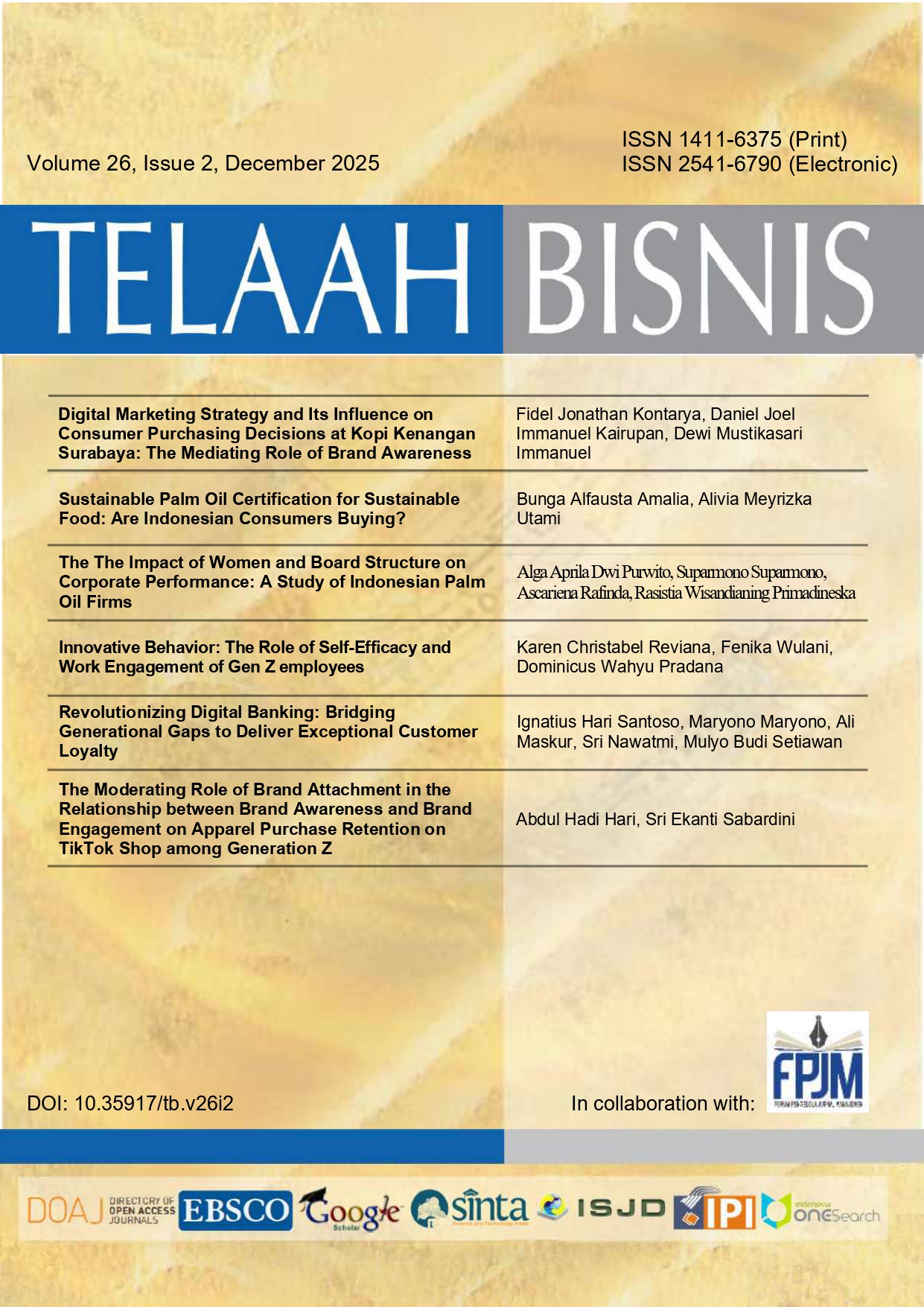
Sustainable Palm Oil Certification for Sustainable Food: Are Indonesian Consumers Buying?
DOI:
https://doi.org/10.35917/tb.v26i2.620Keywords:
Cognitive–Affective–Behavior, RSPO Certification, green purchasing behavior, green foodAbstract
Consumers are increasingly hesitant to engage in widespread greenwashing practices in palm oil products. The Roundtable on Sustainable Palm Oil (RSPO) exists as an international standard aimed at encouraging consumer consumption towards more sustainable palm oil. This study uses the Cognitive–Affective–Behavioral (CAB) framework to analyze factors influencing green purchasing behavior for RSPO-labeled food products in Indonesia. The cognitive dimension is represented by green brand image and green brand loyalty, while the affective dimension is represented by green brand love. This is a quantitative study using a survey method. A total of 303 respondents were collected through a purposive sampling technique with the criteria of knowing the RSPO certification and label and having purchased RSPO-labeled food products in the past three months. Data analysis was conducted using SmartPLS 4.0. The results show that green brand image and green brand loyalty have a positive and significant effect on green purchasing behavior, while green brand love has no significant effect. This suggests that the emergence of emotions towards a brand does not automatically encourage consumers to purchase environmentally friendly products. Future research can use a qualitative approach with in-depth interviews or focus group discussions to understand the reasons behind this phenomenon. The study also recommends other variables such as consumer knowledge about sustainability or risk perception towards sustainable products.
Downloads
References
Amallia, B. A., Utami, A. M., & Suparmono. (2025). The Influence of Greenwashing on Green Purchase Behavior Using Expectations Confirmation Theory. WAHANA: Journal of Economics, Management and Accounting, 28(1). https://doi.org/10.35591/wahana.v28i1.942
Central Statistics Agency. 2021. “Results of the 2020 Population Census.” Central Statistics Agency. Accessed March 25, 2022. https://www.bps.go.id/pressrelease/2021/01/21/1854/hasil-sensus-penduduk-2020.html
Bagozzi, R. P., Gopinath, M., & Nyer, P. U. (1999). The role of emotions in marketing. Journal of the Academy of Marketing Science, 27(2), 184–206. https://doi.org/10.1177/0092070399272005
Bigliardi, B., Bertolini, M., Mourad, M., & Serag Eldin Ahmed, Y. (2012). Perception of green brand in an emerging innovative market. European Journal of Innovation Management, 15(4), 514–537. https://doi.org/10.1108/14601061211272402
Carroll, B. A., & Ahuvia, A. C. (2006). Some antecedents and outcomes of brand love. Marketing Letters 2006 17:2, 17(2), 79–89. https://doi.org/10.1007/S11002-006-4219-2
Chen, Y. S. (2013). Towards green loyalty: driving from green perceived value, green satisfaction, and green trust. Sustainable Development, 21(5), 294–308. https://doi.org/10.1002/SD.500
Chen, Y. S. (2010). The Drivers of Green Brand Equity: Green Brand Image, Green Satisfaction, and Green Trust. Journal of Business Ethics 2009 93:2, 93(2), 307–319. https://doi.org/10.1007/S10551-009-0223-9
Chen, Y. S., Huang, A. F., Wang, T. Y., & Chen, Y. R. (2018). Greenwash and green purchase behaviour: the mediation of green brand image and green brand loyalty. 31(1–2), 194–209. https://doi.org/10.1080/14783363.2018.1426450
Chen, Y. S., Hung, S. T., Wang, T. Y., Huang, A. F., & Liao, Y. W. (2017). The Influence of Excessive Product Packaging on Green Brand Attachment: The Mediation Roles of Green Brand Attitude and Green Brand Image. Sustainability 2017, Vol. 9, Page 654, 9(4), 654. https://doi.org/10.3390/SU9040654
Chin, W. (1998). The Partial Least Squares Approach to Structural Equation Modeling. 295–336. https://doi.org/10.4324/9781410604385-10
Comyns, B., & D’Antone, S. (2025). The moral legitimation of multi-stakeholder Initiatives: The case of the Roundtable on Sustainable Palm Oil (RSPO). Journal of Cleaner Production, 519, 145963. https://doi.org/10.1016/J.JCLEPRO.2025.145963
D’Souza, C., Taghian, M., Apaolaza, V., Hartmann, P., Brouwer, A., & Chowdhury, B. (2022). Consumer Self-Confidence in Green Foods: An Investigation of the Role of Ecolabels Using the Theory of Planned Behavior and Market Segmentation. Journal of International Food and Agribusiness Marketing, 34(5), 457–487. https://doi.org/10.1080/08974438.2021.1901826
Dai, B., Ali, A., & Wang, H. (2020). Exploring information avoidance intention of social media users: a cognition–affect–conation perspective. Internet Research, 30(5), 1455–1478. https://doi.org/10.1108/INTR-06-2019-0225
Dassanayake, S. P., & Nawarathna, L. S. (2025). A machine learning-based approach for predicting the level of palm oil adulteration in coconut oil. Journal of Food Composition and Analysis, 137, 106969. https://doi.org/10.1016/J.JFCA.2024.106969
de Vos, R. E., Suwarno, A., Slingerland, M., van der Meer, P. J., & Lucey, J. M. (2023). Pre-certification conditions of independent oil palm smallholders in Indonesia. Assessing prospects for RSPO certification. Land Use Policy, 130, 106660. https://doi.org/10.1016/J.LANDUSEPOL.2023.106660
Guadalupe, G. A., Lerma-García, M. J., Fuentes, A., Barat, J. M., Bas, M. del C., & Fernández-Segovia, I. (2019). Presence of palm oil in foodstuffs: consumers’ perception.British Food Journal, 121(9), 2148–2162. https://doi.org/10.1108/BFJ-09-2018-0608
Giam, X., Mani, L., Koh, L. P., & Tan, H. T. W. (2016). Saving Tropical Forests by Knowing What We Consume. Conservation Letters, 9(4), 267–274. https://doi.org/10.1111/CONL.12209;CTYPE:STRING:JOURNAL
Hair, J. F., Hult, G. T., Ringle, C., & Sarstedt, M. (2017). A Primer on Partial Least Squares Structural Equation Modeling (PLS-SEM) - Joseph F. Hair, Jr., G. Tomas M. Hult, Christian Ringle, Marko Sarstedt. In Sage.
Hameed, A. A., & Anwar, K. (2018). Analyzing the Relationship between Intellectual Capital and Organizational Performance: A Study of Selected Private Banks in Kurdistan. International Journal of Social Sciences & Educational Studies, 4(4), 39–52. https://doi.org/10.23918/IJSSES.V4I4P39
Hameed, I., Hyder, Z., Imran, M., & Shafiq, K. (2021). Greenwash and green purchase behavior: an environmentally sustainable perspective. Environment, Development and Sustainability, 23(9), 13113–13134. https://doi.org/10.1007/S10668-020-01202-1/METRICS
Havlena, W. J., & Holbrook, M. B. (1986). The Varieties of Consumption Experience: Comparing Two Typologies of Emotion in Consumer Behavior. Journal of Consumer Research, 13(3), 394–404. https://doi.org/10.1086/209078
Hegner, S. M., Fenko, A., & Teravest, A. (2017). Using the theory of planned behaviour to understand brand love. Journal of Product and Brand Management, 26(1), 26–41. https://doi.org/10.1108/JPBM-06-2016-1215/FULL/PDF
Hinkes, C., & Christoph-Schulz, I. (2020). No palm oil or certified sustainable palm oil? Heterogeneous consumer preferences and the role of information. Sustainability (Switzerland), 12(18), 1–26. https://doi.org/10.3390/su12187257
Hilmi, Y. S., Nugroho, A. D., Hasan, M. A., Lakner, Z., Unger-Plasek, B., & Temesi, Á. (2025). Regional analysis in consumer preferences for sustainable palm oil foods: A systematic review. Trends in Food Science & Technology, 162, 105102. https://doi.org/10.1016/J.TIFS.2025.105102
Huo, C., Hameed, J., Zhang, M., Fahme Bin Mohd Ali, A., & Alif Amri Nik Hashim, N. (2022).Modeling the impact of corporate social responsibility on sustainable purchase intentions: insights into brand trust and brand loyalty. 35(1), 4710–4739. https://doi.org/10.1080/1331677X.2021.2016465
Hussin, H., & Abdul Wahid, N. (2023). Conceptualizing Customer Experience in Organic Food Purchase Using Cognitive-Affective-Behavior Model. Journal of Governance and Integrity, 6(2), 577–586. https://doi.org/10.15282/jgi.6.2.2023.9732
Kerdpitak, C., & Mekkham, W. (2019).The mediating roles of green brand image and attitude of green branding in the relationship between attachment of green branding and excessive product packaging. https://rua.ua.es/dspace/handle/10045/100275
Khandeparkar, K., & Motiani, M. (2018). Fake-love: brand love for counterfeits. Marketing Intelligence and Planning, 36(6), 661–677. https://doi.org/10.1108/MIP-11-2017-0278/FULL/XML
Kim, Y., & Choi, S. M. (2005). Antecedents of Green Purchase Behavior: an Examination of Collectivism, Environmental Concern, and Pce. ACR North American Advances, NA-32. https://www.acrwebsite.org/volumes/9156/volumes/v32/NA-32
Larsen, R. K., Osbeck, M., Dawkins, E., Tuhkanen, H., Nguyen, H., Nugroho, A., Gardner, T. A., Zulfahm, & Wolvekamp, P. (2018). Hybrid governance in agricultural commodity chains: Insights from implementation of ‘No Deforestation, No Peat, No Exploitation’ (NDPE) policies in the oil palm industry. Journal of Cleaner Production, 183, 544–554. https://doi.org/10.1016/J.JCLEPRO.2018.02.125
Le, Thi Hong Hao, Thi Quynh Hoa Nguyen, Cao Son Tran, Thi Trang Vu, Thi Lien Nguyen, Van Hoang Cao, Thi Thao Ta, Thi Ngoc Mai Pham, Thi Anh Huong Nguyen, dan Thanh Duc Mai. 2017. Screening Determination of Food Additives Using Capillary Electrophoresis Coupled with Contactless Conductivity Detection: A Case Study in Vietnam.Food Control. 77:281–89. https://doi.org/10.1016/j.foodcont.2017.02.020
Leonidou, Constantinos N., dan Dionysis Skarmeas. 2017. Gray Shades of Green: Causes and Consequences of Green Skepticism. Journal of Business Ethics 2015 144:2 144(2):401–15. https://doi.org/10.1007/s10551-015-2829-4
Lieke, S. D., Spiller, A., & Busch, G. (2023). Can consumers understand that there is more to palm oil than deforestation? Sustainable Production and Consumption, 39, 495–505. https://doi.org/10.1016/J.SPC.2023.05.037
Lieke, S. D., Spiller, A., & Busch, G. (2024). Are consumers still barking up the wrong (palm) tree? Insights into perceptions towards palm oil-related labels and claims. Food Quality and Preference, 120, 105258. https://doi.org/10.1016/J.FOODQUAL.2024.105258
Lim, S. H., & Kim, D. J. (2020). Does Emotional Intelligence of Online Shoppers Affect Their Shopping Behavior? From a Cognitive-Affective-Conative Framework Perspective. International Journal of Human-Computer Interaction, 36(14), 1304–1313. https://doi.org/10.1080/10447318.2020.1739882;REQUESTEDJOURNAL:JOURNAL:HIHC20
Lin, J., Lobo, A., & Leckie, C. (2017). Green brand benefits and their influence on brand loyalty. Marketing Intelligence and Planning, 35(3), 425–440. https://doi.org/10.1108/MIP-09-2016-0174/FULL/XML
Liu, Y., Segev, S., & Villar, M. E. (2017). Comparing two mechanisms for green consumption: cognitive-affect behavior vs theory of reasoned action. Journal of Consumer Marketing, 34(5), 442–454. https://doi.org/10.1108/JCM-01-2016-1688
Loh, X. M., Lee, V. H., Hew, T. S., & Lin, B. (2022). The cognitive-affective nexus on mobile payment continuance intention during the COVID-19 pandemic. International Journal of Bank Marketing, 40(5), 939–959. https://doi.org/10.1108/IJBM-06-2021-0257
Majeed, M. U., Aslam, S., Murtaza, S. A., Attila, S., & Molnár, E. (2022). Green Marketing Approaches and Their Impact on Green Purchase Intentions: Mediating Role of Green Brand Image and Consumer Beliefs towards the Environment. Sustainability 2022, Vol. 14, Page 11703, 14(18), 11703. https://doi.org/10.3390/SU141811703
Martins, J. M., Aftab, H., Mata, M. N., Majeed, M. U., Aslam, S., Correia, A. B., & Mata, P. N. (2021). Assessing the Impact of Green Hiring on Sustainable Performance: Mediating Role of Green Performance Management and Compensation. International Journal of Environmental Research and Public Health 2021, Vol. 18, Page 5654, 18(11), 5654. https://doi.org/10.3390/IJERPH18115654
Mata, M., Aftab, H., Martins, J., J, S. A.-… . Strateg. Manag., & 2021, undefined. (2021). The role of intellectual capital in shaping business performance: Mediating role of innovation and learning. Academy of Strategic Management Journal , 20, 1–14. https://www.academia.edu/download/68707134/the_role_of_intellectual_capital_in_shaping_business_performance_mediating_role_of_innovation_and_learning.pdf
Neuman, D. (2014). Qualitative research in educational communications and technology: a brief introduction to principles and procedures. Journal of Computing in Higher Education 2014 26:1, 26(1), 69–86. https://doi.org/10.1007/S12528-014-9078-X
Oliphant, E., & Simon, A. C. (2022). The cost of sustainable palm oil: Should an Indonesian smallholder pursue RSPO-certification? World Development Perspectives, 26, 100432. https://doi.org/10.1016/J.WDP.2022.100432
Ostfeld, R., Howarth, D., Reiner, D., & Krasny, P. (2019). Peeling back the label—exploring sustainable palm oil ecolabelling and consumption in the United Kingdom. Environmental Research Letters, 14(1), 014001. https://doi.org/10.1088/1748-9326/AAF0E4
Panda, T. K., Kumar, A., Jakhar, S., Luthra, S., Garza-Reyes, J. A., Kazancoglu, I., & Nayak, S. S. (2020). Social and environmental sustainability model on consumers’ altruism, green purchase intention, green brand loyalty and evangelism. Journal of Cleaner Production, 243, 118575. https://doi.org/10.1016/J.JCLEPRO.2019.118575
Robertson, J., Botha, E., Ferreira, C., & Pitt, L. (2022). How deep is your love? The brand love-loyalty matrix in consumer-brand relationships. Journal of Business Research, 149, 651–662. https://doi.org/10.1016/j.jbusres.2022.05.058
Salehzadeh, R., Sayedan, M., Mirmehdi, S. M., & Heidari Aqagoli, P. (2023). Elucidating green branding among Muslim consumers: the nexus of green brand love, image, trust and attitude. Journal of Islamic Marketing, 14(1), 250–272. https://doi.org/10.1108/JIMA-08-2019-0169
Santika, T., Wilson, K. A., Budiharta, S., Law, E. A., Poh, T. M., Ancrenaz, M., Struebig, M. J., & Meijaard, E. (2019). Does oil palm agriculture help alleviate poverty? A multidimensional counterfactual assessment of oil palm development in Indonesia. World Development, 120, 105–117. https://doi.org/10.1016/J.WORLDDEV.2019.04.012
Sundaraja, C. S., Hine, D. W., & Lykins, A. (2020). Confronting the palm oil crisis: Identifying behaviours for targeted interventions. Environmental Science & Policy, 103, 99–106. https://doi.org/10.1016/J.ENVSCI.2019.08.004
Schmuck, D., J. Matthes, dan Brigitte Naderer. (2018). Misleading Consumers with Green Advertising? An Affect–Reason–Involvement Account of Greenwashing Effects in Environmental Advertising. Journal of Advertising. 47(2):127–45. https://doi.org/10.1080/00913367.2018.1452652
VanderWilde, C. P., Newell, J. P., Gounaridis, D., & Goldstein, B. P. (2023). Deforestation, certification, and transnational palm oil supply chains: Linking Guatemala to global consumer markets. Journal of Environmental Management, 344, 118505. https://doi.org/10.1016/J.JENVMAN.2023.118505
Wassmann, B., Siegrist, M., & Hartmann, C. (2023). Palm oil and the Roundtable of Sustainable Palm Oil (RSPO) label: Are Swiss consumers aware and concerned? Food Quality and Preference, 103, 104686. https://doi.org/10.1016/J.FOODQUAL.2022.104686
Watson, A., Perrigot, R., & Dada, O. (2024). The effects of green brand image on brand loyalty: The case of mainstream fast food brands. Business Strategy and the Environment, 33(2), 806–819. https://doi.org/10.1002/BSE.3523
Wu, H.-C., & Chen, G. (2020). An empirical study of green brand supportive intentions: the case of Acer. International Conference on Economic Management and Model. https://ieeexplore.ieee.org/abstract/document/8988477/
Wu, W., Zhang, A., van Klinken, R. D., Schrobback, P., & Muller, J. M. (2021). Consumer Trust in Food and the Food System: A Critical Review. Foods 2021, Vol. 10, Page 2490, 10(10), 2490. https://doi.org/10.3390/FOODS10102490
World Bank. (2019) Aspiring Indonesia-Expanding the Middle Class. https://www.worldbank.org/en/news/press-release/2020/01/30/expanding-middle-class-key-for-indonesia-future
Downloads
Published
How to Cite
Issue
Section
Citation Check
License
Copyright (c) 2025 Bunga Alfausta Amalia, Alivia Meyrizka Utami

This work is licensed under a Creative Commons Attribution 4.0 International License.

This work is licensed under a Creative Commons Attribution 4.0 International License.
Authors who publish with this journal agree to the following terms:
- Authors retain copyright and grant the journal right of first publication with the work simultaneously licensed under a Creative Commons Attribution 4.0 International License that allows others to share the work with an acknowledgement of the work's authorship and initial publication in this journal.
- Authors are able to enter into separate, additional contractual arrangements for the non-exclusive distribution of the journal's published version of the work (e.g., post it to an institutional repository or publish it in a book), with an acknowledgement of its initial publication in this journal.
- Authors are permitted and encouraged to post their work online (e.g., in institutional repositories or on their website) prior to and during the submission process, as it can lead to productive exchanges, as well as earlier and greater citation of published work (See The Effect of Open Access).