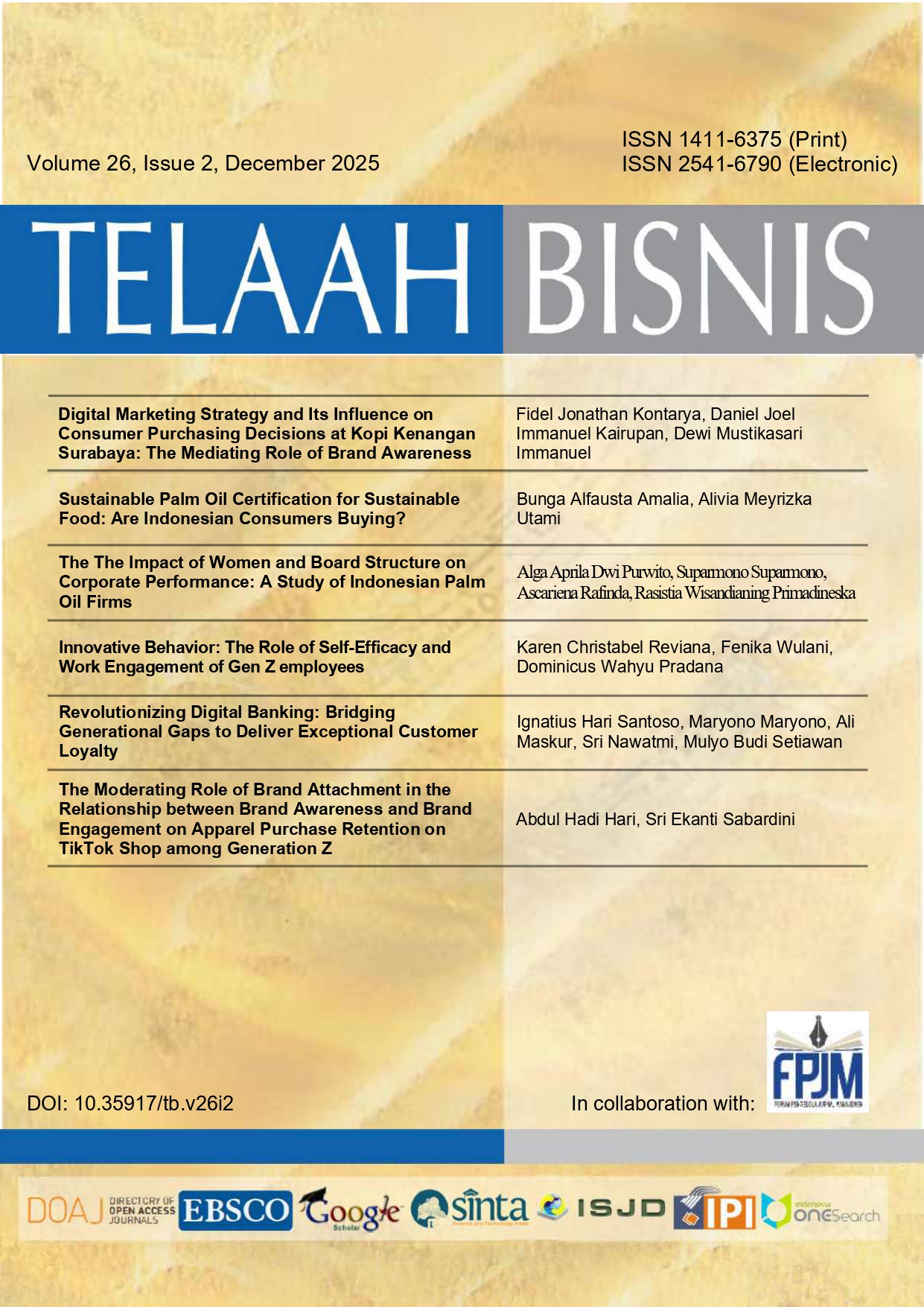
The Moderating Role of Brand Attachment in the Relationship between Brand Awareness and Brand Engagement on Apparel Purchase Retention on TikTok Shop among Generation Z
DOI:
https://doi.org/10.35917/tb.v26i2.638Keywords:
brand, awareness, engagement, attachment, purchase, retentionAbstract
This study is conducted in the context of the growing use of social media-based e-commerce platforms, particularly TikTok Shop, by Generation Z for purchasing apparel products. This phenomenon highlights the need to understand the factors influencing consumer loyalty, especially those related to brand awareness, consumer engagement, and emotional attachment to brands. The aim of this research is to analyze the influence of Brand Awareness and Brand Engagement on Purchase Retention, as well as to evaluate the moderating role of Brand Attachment in strengthening these relationships. The study employs a correlational quantitative research design using a survey method. The population consists of Generation Z consumers who have previously purchased apparel products via TikTok Shop. A purposive sampling technique was used, resulting in 150 respondents. Data were analyzed using SmartPLS software to examine both the direct relationships and the moderating effects among variables. The findings reveal that both Brand Awareness and Brand Engagement positively affect Purchase Retention. Moreover, Brand Attachment is proven to moderate these relationships, indicating that emotional attachment to the brand strengthens the influence of brand awareness and engagement on purchase loyalty. This research contributes theoretically by reinforcing the model of relationships among awareness, engagement, attachment, and purchase retention within the context of social media-based e-commerce. Practically, the findings offer valuable insights for marketers in designing strategies to enhance consumer loyalty by increasing awareness, fostering engagement, and building emotional attachment to brands on digital platforms.
Downloads
References
Azzari, V., & Pelissari, A. (2020). Does brand awareness influences purchase intention? The mediation role of brand equity dimensions. BBR. Brazilian Business Review, 17(6), 669–685.
Barreda, A., Bilgihan, A., & Okumus, F. (2023). The impact of brand awareness and customer engagement on brand loyalty in the hospitality industry. International Journal of Hospitality Management, 45(2), 123–136.
Batra, R., Ahuvia, A., & Bagozzi, R. P. (2023). Brand love: Development and validation of a practical model. Journal of Marketing, 78(2), 1–16.
Bowlby, J. (1969). Attachment and loss: Volume I: Attachment. Basic Books.
Brodie, R., Hollebeek, L., Juri c, B., & Ili c, A. (2023). Customer engagement: conceptual domain, fundamental propositions, and implications for research. Journal of Service Research, 14(3), 252–271. https://doi.org/10.1177/1094670511411703
Chankoson, T., & Thabhiranrak, T. (2019). The moderating role of brand awareness between the relationship of emotional attachment, brand relationship and positive word of mouth. Polish Journal of Management Studies, 20(1), 129–138.
Chaudhuri, A., & Holbrook, M. B. (2023). The chain of effects from brand trust and brand affect to brand performance: the role of brand loyalty. Journal of Marketing, 65(2), 81–93. https://doi.org/10.1509/jmkg.65.2.81.18255
Ghozali, I., & Latan, H. (2015). Partial Least Squares: Konsep, Teknik dan Aplikasi Menggunakan Program SmartPLS 3.0 (2nd ed.). Badan Penerbit Universitas Diponegoro.
Goyal, A., & Verma, P. (2024). The relationship between brand engagement, brand loyalty, overall brand equity and purchase intention. Journal of Strategic Marketing, 32(1), 65–79. https://doi.org/10.1080/0965254X.2022.2149839
Hair, J. F., Hult, G. T. M., Ringle, C., & Sarstedt, M. (2019). A Primer on Partial Least Squares Structural Equation Modeling (PLS-SEM) (2nd ed.). Sage Publications.
Hollebeek, L. D., Srivastava, R. K., & Chen, T. (2023). S-D logic perspectives on consumer engagement: The role of engagement in the generation of value. Journal of the Academy of Marketing Science, 41(1), 81–94.
Keller, K. L. (2023). Strategic Brand Management: Building, Measuring, and Managing Brand Equity (5th ed.). Pearson Education.
Kim, C., & Ko, E. (2023). The role of social media and online shopping in enhancing customer loyalty and retention: A study on fashion consumers. Journal of Fashion Marketing and Management, 27(2), 222–240.
McKinsey, & Company. (2022). Gen Z and the Future of Fashion: A Global Survey on Apparel and Retail Trends. McKinsey & Company.
Morgan, R. M., & Hunt, S. D. (2023). The commitment-trust theory of relationship marketing. Journal of Marketing, 58(3), 20–38. https://doi.org/10.1177/00222429940580030
Sharma, D. R., & Singh, B. (2023). Understanding the Relationship Between Customer Satisfaction, Customer Engagement and Repeat Purchase Behaviour. Vision, 27(4), 449–457. https://doi.org/10.1177/0972262921992593
Thomson, M., MacInnis, D. J., & Whan Park, C. (2023). The Ties That Bind: Measuring the Strength of Consumers’ Emotional Attachments to Brands. Journal of Consumer Psychology, 15(1), 77–91. https://doi.org/10.1207/s15327663jcp1501_10
Wolff, R. (2025). Gen Zers turn to TikTok and Instagram for product discovery. https://www.emarketer.com/content/gen-z-tiktok-instagram-product-discovery
Downloads
Published
How to Cite
Issue
Section
Citation Check
License
Copyright (c) 2025 Abdul Hadi Hari, Sri Ekanti Sabardini

This work is licensed under a Creative Commons Attribution 4.0 International License.

This work is licensed under a Creative Commons Attribution 4.0 International License.
Authors who publish with this journal agree to the following terms:
- Authors retain copyright and grant the journal right of first publication with the work simultaneously licensed under a Creative Commons Attribution 4.0 International License that allows others to share the work with an acknowledgement of the work's authorship and initial publication in this journal.
- Authors are able to enter into separate, additional contractual arrangements for the non-exclusive distribution of the journal's published version of the work (e.g., post it to an institutional repository or publish it in a book), with an acknowledgement of its initial publication in this journal.
- Authors are permitted and encouraged to post their work online (e.g., in institutional repositories or on their website) prior to and during the submission process, as it can lead to productive exchanges, as well as earlier and greater citation of published work (See The Effect of Open Access).