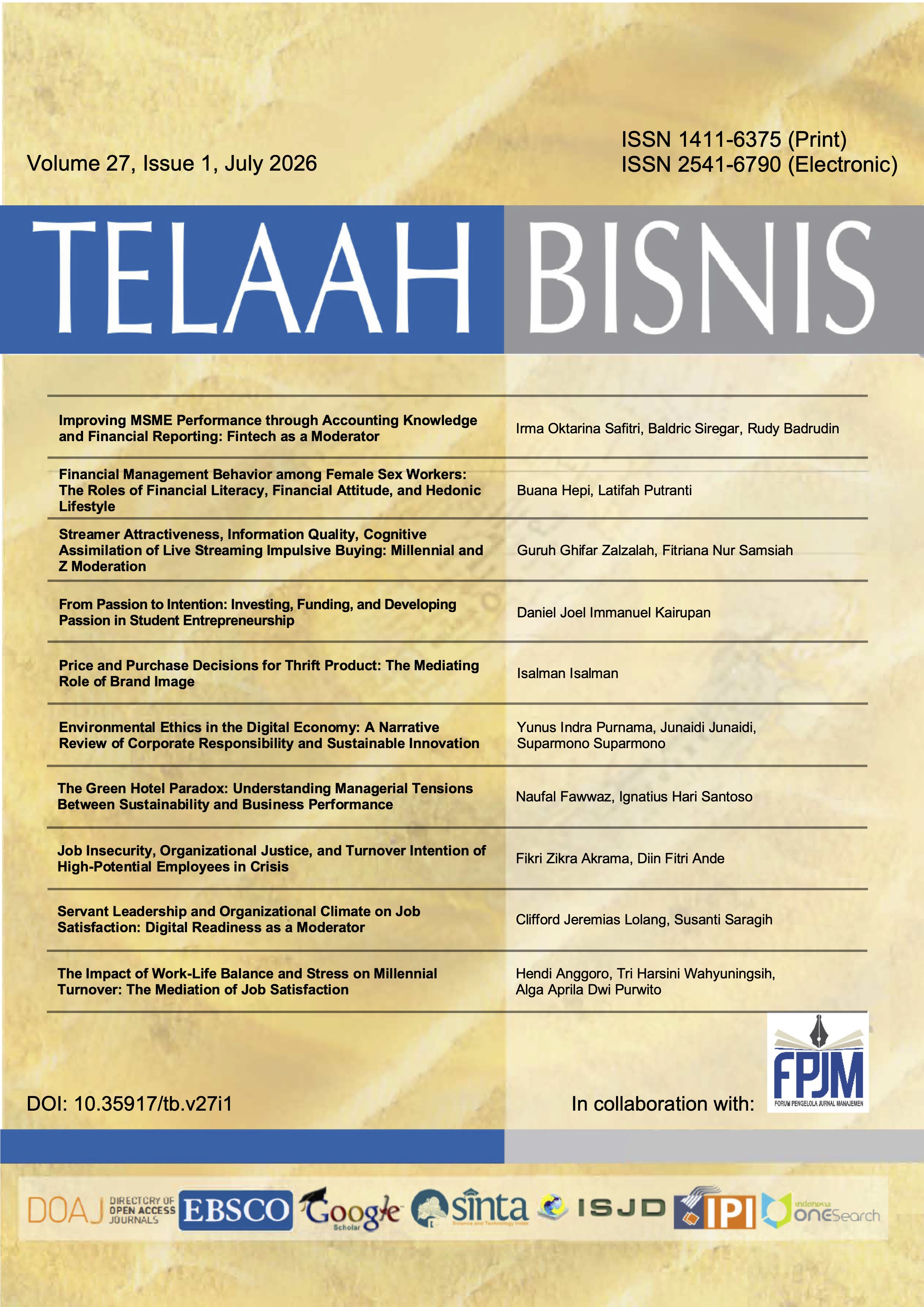
The Green Hotel Paradox: Understanding Managerial Tensions Between Sustainability and Business Performance
DOI:
https://doi.org/10.35917/tb.v27i1.702Keywords:
sustainable performance, perceived tension, green innovation strategyAbstract
The increasing demands on the hotel industry to implement sustainable practices create challenges for hotel managers in balancing environmental goals and business performance. This situation has given rise to the green hotel paradox, a situation where hotels must meet sustainability demands without neglecting business targets. This study aims to understand the dynamics of this managerial tension through the perspective of Paradox Theory by examining the influence of paradox mindset, environmental sustainability orientation, and business performance pressure on perceived tension, as well as their impact on green innovation strategy and sustainable performance. The study used a quantitative approach, surveying 102 hotel managers in various tourist cities in Indonesia. Data were collected using a questionnaire and analyzed using Partial Least Squares–Structural Equation Modeling (PLS-SEM). The results indicate that paradox mindset, environmental sustainability orientation, and perceived tension positively influence the relationships tested. Green innovation strategy has also been shown to improve sustainable performance. However, business performance pressure has no significant effect on perceived tension. This study extends the application of Paradox Theory to the context of green hotels and emphasizes the importance of developing a paradox mindset and green innovation strategy to support organizational sustainability.
Downloads
References
Arun Kumar, P., & Lavanya, V. (2024). Igniting work innovation: performance pressure, extraversion, feedback seeking and innovative behavior. Management Decision, 62(5), 1598-1617, https://doi.org/10.1108/MD-05-2023-0839
Aboelmaged, M. (2018). Direct and indirect effects of eco-innovation, environmental orientation and supplier collaboration on hotel performance: An empirical study. Journal of Cleaner Production, 184, 537-549, https://doi.org/10.1016/j.jclepro.2018.02.192
Acar, A.Z., Acar, P., Aslan, M., Yaylaili, I., & Yilmaz, O.K. (2025). The role of eco-innovation and environmental management accounting in fostering performance effect by green dynamic capabilities in the hotel industry. Sustainability, 17(21), 9487, https://doi.org/10.3390/su17219487
Andriopoulos, C., & Lewis, M.W. (2017). Managing innovation paradoxes: Ambidexterity lessons from leading product design companies. Long Range Planning, 43(1), 104-122, https://doi.org/10.1016/j.lrp.2009.08.003
Asadi, S., Omsalameh, P.S., Nilashi, M., Abdullah, R., Samad, S., Yadegarisdehkordi, E., Aljojo, N., & Razali, N.S. (2020). Investigating influence of green innovation on sustainability performance. Journal of Cleaner Production, 258, 120860, https://doi.org/10.1016/j.jclepro.2020.120860
Ashforth, B.E., Rogers, K.M., Pratt, M.G., & Pradies, C. (2014). Ambivalence in organizations: A multilevel approach. Organization Science, 25(5), 1453-1478, https://doi.org/10.1287/orsc.2014.0909
Awan, U., Sroufe, R., & Kraslawski, A. (2019). Creativity enables sustainable development: Supplier engagement as a boundary condition for green innovation. Journal of Cleaner Production, 226, 172-185, https://doi.org/10.1016/j.jclepro.2019.03.308
Baer, M., & Oldham, G.R. (2006). The curvilinear relation between experienced creative time pressure and creativity. Journal of Applied Pscyhology, 91(4), 963-970, https://doi.org/10.1037/0021-9010.91.4.963
Berti, M., & Cunha, M.P.E. (2022). paradox, dialectics or trade off? a Double loop model of paradox. Journal of Management Studies, 60(4), 861-888, https://doi.org/10.1111/joms.12899
Boemelburg, R., Zimmermann, A., & Palmie, M. (2023). How paradoxical leaders guide their follower to embrace paradox: Cognitive and behavioral mechanism of paradox mindset development. Long Range Planning, 56(4), article 102319, https://doi.org/10.1016/j.lrp.2023.102319
von Bomel, K. (2018). Managing tensions in sustainable business models: Exploring instrumental and integrative strategies. Journal of Cleaner Production, 196, 829-841, https://doi.org/10.1016/j.jclepro.2018.06.063
Carmine, S., & de Marchi, V. (2022). Tensions and outcomes in corporate sustainability: The moderating role of paradoxical frame. Journal of Cleaner Production, 380, article 134952, https://doi.org/10.1016/j.jclepro.2022.134952
Caniels, M.C.J., & Hatak, I. (2022). Employee resilience and paradox mindset. European Management Journal, 40(5), 791-803, https://doi.org/10.1016/j.emj.2021.10.001
Cao, H., & Chen, Z. (2019). The driving effect of internal and external environment on green innovation strategy-The moderating role of top management’s environmental awareness. Nankai Business Review International. 10(3), 342-361, https://doi.org/10.1108/nbri-05-2018-0028
Clauss, T., Kraus, S., Kallinger, F.L., Bican, P.M., Brem, A., & Kailer, N. (2021). Organizational ambidexterity and competitive advantage: The role of strategic agility in the exploration-exploitation paradox. Journal of Innovation & Knowledge, 6(4), 203-213, https://doi.org/10.1016/j.jik.2020.07.003
Duta-Powell, R., Rhee, J.J., & Wodak, S. (2024). Two intervention for mitigating the harms of greenwashing on consumer perceptions. Business Strategy and the Environment, 33(2), 882-903, https://doi.org/10.1002/bse.3520
Fernando, Y., Chiappetta Jabbour C.J.., & Wah, W.X. (2019). Pursuing green growth in technology firms through the connections between environmental innovation and sustainable business performance: Does service capability matter? Resources, Conservation and Recycling, 141, 8-20, https://doi.org/10.1016/j.resconrec.2018.09.031
Ferreira, S., Pereira, O., & Simoes, C. (2024). Determinants of consumers’ intention to visit green hotels: Combining psychological and contextual factors. Journal of Vocation Marketing, 30(2), 185-203, https://doi.org/10.1177/13567667231217755
Hair, J.F., Hult, G.T.M., Ringle, C.M., & Sarstedt, M. (2022). A primer on partial least squares structural equation modeling (PLS-SEM), 3rd ed. Sage Publications.
Henseler, J., Ringle, C.M., Sarstedt, M. (2015). A new criterion for assessing dicriminant validity in variance-based structural equation modeling. Journal of the Academy of Marketing Science, 43(1), 115-135, https://doi.org/10.1007/s11747-014-0403-8
Herr, R.M., Birmingham, W.C., van Harreveld, F., van Vianen, A.E.M., Fischer, J.E., & Bosch, J.A. (2022). The relationship between ambivalence towards supervisors behavior and employee’s mental health. Scientific Reports, 12(1), 9555, https://doi.org/10.1038/s41598-022-13533-2
Hu, D., Qiu, L., She, M., & Wang, Y. (2021). Sustaining the sustainable development: How do firms turn government green subsidies into financial performance through green innovations? Business strategy and the Environment, 30(5), 2271-2291, https://doi.org/10.1002/bse.2746
Jarzabkowski, P., & Le, J.K. (2017). We have to do this and that? You must be joking: Constructing and responding to paradox through humor. Organization Studies, 38(3-4), 433-462, https://doi.org/10.1177/0170840616640846
de Jong, M.D.T., Harkink, K.M., & Barth, S. (2018). Making green stuff? Effects of corporate greenwashing on consumers. Journal of Business and Technical Communication, 32(1), 77-112, https://doi.org/10.1177/1050651917729863
Khatter, A. (2023). Challenges and solutions for environmental sustainability in the hospitality sector. Sustainability, 15(15), article 11491, https://doi.org/10.3390/su151511491
Knight, E., & Paroutis, S. (2017). Becoming salient: The TMT leader’s role in shaping the interpretive context of paradoxical tension. Organization Studies, 38(3-4), 403-432, https://doi.org/10.1177/0170840616640844
Lee, A., Lyubovnikova, J., Zheng, Y., & Li, Z.F. (2023). Paradoxcical leadership: A meta analytical review. Frontier in Organizational Psychology, 1 article 1229543, https://doi.org/10.3389/forgp.2023.1229543
Leonidou, L.C., Christodoulides, P., Kyrgidou, L.P., & Palihawadana, D. (2017). Internal drivers and performance consequences of small firm green business strategy. Journal of Business Ethics, 140(3), 585-606, https://doi.org/10.1007/s10551-015-2670-9
Leonidou, L.C., Palihawadana, D., Aykol, B., & Christodoulides, P. (2022). Effective small and medium-sized enterprise import strategy: Its drivers, moderators, and outcomes. International Marketing Review, 39(1), 36-65, https://doi.org/10.1177/1069031X211064278
Liu, M., Liu, L., & Feng, A. (2024). The impact of green innovation on corporate performance: An analysis based on substantive and strategic green innovations. Sustainability, 16(6), article 2588, https://doi.org/10.3390/su16062588
Liu, Y., Xu, S., & Zhang, B. (2019). Thriving at works: How a paradox mindset influences innovative work behavior. The Journal of Applied Behavioral Science, 56(3), 347-366, https://doi.org/10.1177/0021886319888267
Lopez-Gamero, M.D., Molina-Azorin, J.F., Pereira-Moliner, J., & Pertusa-Ortega, E.M. (2022). Agility, innovation, environmental management and competitiveness in the hotel industry. Corporate Social Responsibility and Environmental Management, 30(2), 548-562, https://doi.org/10.1002/csr.2373
Lusianti, D., & Santoso, I.H. (2026). Greening hotel, greeying beliefs: The unexpected outcomes of zero-waste management. Management Analysis Journal, 15(1), 82-89, https://doi.org/10.15294/maj.v15i1.39263
Mena, S., & parker, S. (2024). The temporal structuring of corporate sustainability. Journal of Business Ethics, 195(1), 1-12, https://doi.org/10.1007/s10551-024-05648-5
Merli, R., Preziosi, M., & Acampora, A. (2019). How do scholars approach the circular economy? A systematic literature review. Journal of Cleaner Production, 178, 703-722, https://doi.org/10.1016/j.jclepro.2017.12.112
Mignon, I., & Bankel, A. (2023). Sustainable business model and innovation strategies to realize them: A review of 87 empirical cases. Business Strategy and the Environment, 32(4), 1357-1372, https://doi.org/10.1002/bse.3192
Miranda, S.M., Wang, D., & Tian, C.A. (2022). Discursive fields and the diversity coherence paradox: An ecological perspective on blockchain community discourse. MIS Quarterly, 46(3), 1421-1452, https://doi.org/10.25300/MISQ/2022/15736
Miron-Spektor, E., Ingram, A., Keller, J., Smith, W.K., & Lewis, M.W. (2018). Microfoundation of organizational paradox: The problem is how we think about the problem. Academy of Management Journal, 61(1), 26-45, https://doi.org/10.5465/amj.2016.0594
Mitchell, M.S., Baer, M.D., Ambrose, M.L., Folger, R., & Palmer, N.F. (2018). Cheating under pressure: a Self-protection model of workforce chaeting behavior. Journal of Applied Psychology, 103(1), 54-73, https://doi.org/10.1037/apl0000254
Mzembe, A.., Idemudia, U., & Angel, M.E., (2021). Sustainability led innovations in the hospitality industry: A case study of the adoption of the green key scheme standard in the Netherlands. Journal of Cleaner Production, 291, article 125210, https://doi.org/10.1016/j.jclepro.2020.125210
Niloy, A.C., Sultana, J., Alam, J.B., Ghosh, A., & Farhan, K.M. (2023). What triggers you to buy green products? Explaining through an extended TPB model. Asia-Pacific Journal of Management Research and Innovation, 19(1), 25-39, https://doi.org/10.1177/2319510X231171195
Patwary, A.K., Rasoolimanesh, S.M., Rabiul, M.K., Aziz, R.C., & Hanafiah, M.H. (2022). Linking environmental knowledge, environemtnal responsibility, altruism, and intention toward green hotel through ecocentric and anthropocentric attitutes. International of Contemporary Hospitality Management, 34(12), 4653-4673, https://doi.org/10.1108/IJCHM-01-2022-0039
Potonik, K., Verwaeren, B., & Nijstad, B. (2022). Tension and paradoxes in creativity and innovation. Journal of Work and Organizational Psychology, 38(3), 149-163, https://doi.org/10.5093/jwop2022a19
Pradapa, S.Y.F., & Santoso, I.H. (2021). Upaya meningkatkan okupansi hotel selama masa pandemi Covid 19 dengan memanfaatkan online review pada aplikasi pegipegi dan traveloka. Jurnal Pariwisata Pesona, 6(2), 161-167, https://doi.org/10.26905/jpp.v6i2.5242
Putnamm, L.L., Fairhurst, G.T., & Banghart, S. (2016). Contradictions, dialectics and paradoxes in organizations: A constitutive approach. Academy of Management Annals, 10(1), 65-171, https://doi.org/10.5465/19416520.2016.1162421
Raisch, S., Hargrave, T.J., & van den Ven, A.H. (2018). The learning spiral: A process perspective on paradox. Journal of Management Studies, 55(8), 1507-1526, https://doi.org/10.1111/joms.12397
Raza, S.A., & Khan, K.A. (2022). Impact of green human resource practice on hotel environment performance: The moderating effect of environmental knowledge and individual green values. International Journal of Contemporary Hospitality Management, 34(6), 2154-2175, https://doi.org/10.1108/IJCHM-05-2021-0553
Schad, J., Lewis, M.W., Raisch, S., & Smith, W.K. (2016). Paradox research in management science: Looking back to move forward. Academy of Management Annals, 10(1), 5-64, https://doi.org/10.5465/19416520.2016.1162422
Sender, A., & Mormann, H. (2024). It takes a fool to remain sane: How and when HR executives use jesting techniques to trickle up paradoxical tensions. Journal of Management Inquiry, 34(2), https://doi.org/10.1177/10564926241239546
Seo, J., Kim, C.S., Kim, B.S., & park, S. (2024). Customer’s behavioral intentions in relation to sustainabel green marketing activities in hotels. SAGE Open, 14(2), 1-13, https://doi.org/10.1177/21582440241247655
Sharma, G., & Bansal, P. (2020). Cocreating rigorous and relevant knowledge. Academy of Management journal, 63(2), 386-410, https://doi.org/10.5465/amj.2016.0487
Shao, Y., Nijstad, B.A., & Tauber, S. (2019). Creativity under workload pressure and integrative complexity: The double-edge sword of paradoxcical leadership. Organizational Behavior and human Decision Process, 155, 7-19, https://doi.org/10.1016/j.obhdp.2019.01.008
Sheep, M.L., Fairhurst, G.T., & Khazanchi, S. (2017). Knots in the discourse of innovation: Investigating multiple tension in a reqcquired spin-off. Oragnization Studies, 38(3-4), 463-488, Journal of Management Studies, 54(5), 593-620, https://doi.org/10.1177/0170840616640845
Siddiqui, H., & Farooq, A. (2025). Environmental strategies in hotel industry: a Systematic framework-based review and future research direction. International Journal of Environmental Sciences, 11(7), 223-238, https://doi.org/10.64252/xt1hr232
Singh, S.K., del Giudice, M., Chierici, R., & Graziano, D. (2020). Green innovation and environmental performance: The role of green transformational leadership and green human resources management . Technological Forecasting and Social Change, 150, article 119762, https://doi.org/10.1016/j.techfore.2019.119762
Shmueli, G., Sarstedt, M., Hair, J.F., Cheah, J.H., Ting, H., Vaithilingam, S., & Ringle, C.M. (2019). Predictive model assessment in PLS-SEM: Guidelines for using PLSpredict. European Journal of Marketing, 53(11), 2322-2347, https://doi.org/10.1108/EJM-02-2019-0189
Sparr, J.L., Miron-Spektor, E., Lewis, M.W., & Smith, W.K. (2022). From a label to a metatheory of paradox: If we change the way we look at things, the things we look at change. Academy of Management Collections, 1(2), 16-34, https://doi.org/10.5465/AMC.2021.0006
Talukder, S.C., Lakner, Z., & Temesi, A. (2025). Entrepreneurship education and sustainable entrepreneurial intention: the Mediating role of attitudes and the moderating role of prior entrepreneurial experience. SAGE Open, 15(4), 1-17, https://doi.org/10.1177/21582440251383194
Tariq, A., Badir, Y.F., & Chonglerttham, S. (2019). Green innovation and firm performance: Moderation analyses from Tahiland. European Journal of Innovation Management, 22(3), 446-467, https://doi.org/10.1108/EJIM-07-2018-0148
Tjemkes, B., Schad, J., Uslu, D., & Konjin, N. (2025). Cultivating a collective paradox mindset: Design principles for learning interventions. Academy of Management Learning & Education, 24(3), 287-316, https://doi.org/10.5465/amle.2023.0553
Vargas-Merino J.A., Rios-Lama, C.A., & Panez-Bendezu, M.H. (2022). Circular economy: Approaches and perspectives of a variable with a growing trend in the scientific world- A systematic review of the last 5 years. Sustainability, 14(22), 14682, https://doi.org/10.3390/su142214682
Verma, V.K., Chandra, B., & Kumar, S. (2019). Values and ascribed responsibility to predict consumer’s attitude and concern towards green hotel visit intention. Journal of Business Research, 96, 206-216, https://doi.org/10.1016/j.jbusres.2018.11.021
Vourio, A.M., Puumalainen, K., & Fellnhofer, K. (2018). Drivers of entrepreneurial intentions in sustainable entrepreneurhsip. International Journal of Entrepreneurial Behavior & Research, 24(2), 359-381, https://doi.org/10.1108/IJEBR-03-2016-0097
`Xie, X., Huo, J., & Zou, H. (2019). Green proces innovation, green product innovation, and corporate financial performance: A content analysis method. Journal of Business Research, 101, 697-706, https://doi.org/10.1016/j.jbusres.2019.01.010
Xu, X., Wang, Y., Li., M., & Kwan, H.K. (2021). Paradoxical effects of performance pressure on employee’s in-role behavior: An approach/ avoidance model. Frontier in Osychology, 12 article 74404, https://doi.org/10.3389/fpsyg.2021.744404
Yadav, R., & Pathak, G.S. (2017). Determinants of consumer’s green purchase behavior in a developing nation: Applying and extending the theory of planned behavior. Ecological Economics, 134, 114-122, https://doi.org/10.1016/j.ecolecon.2016.12.019
Yu, W., Chavez, R., Jacobs, M.A., & Feng, M. (2018). Data-driven supply chains and organizational pressure: A resource-based view. Transportation Research Part E: Logistic and Transportation Review, 114, 371-385, https://doi.org/10.1016/j.tre.2017.04.002
Yusliza, M.Y., Yong, J.Y., Tanveer, M.I., Ramayah, T., Noor Faezah, J., & Muhammad, Z. (2020). A structural model of the impact of green intelectual capital on sustainable performance. Journal of Cleaner Production, 249, 119334, https://doi.org/10.1016/j.jclepro.2019.119334
Zhang, Q., Zhu, X., & Lee, M.J. (2024). Exploring insitiutional pressures, green innovations, and sustainable performance: Examining the mediated moderation role of entrepreneurial orientation. Sustainability, 16(5), article 2058, https://doi.org/10.3390/su16052058
Zhang, Y., Zhang, Y., Law, K.S., & Zhou, J. (2022). Paradoxical leadership, subjective ambivalence, and employee creativity: Effect of employee holistic thinking. Journal of Management Studies, 59(3), 695-723, https://doi.org/10.1111/joms.12792
Downloads
Published
How to Cite
Issue
Section
Citation Check
License
Copyright (c) 2026 Naufal Fawwaz, Ignatius Hari Santoso

This work is licensed under a Creative Commons Attribution 4.0 International License.

This work is licensed under a Creative Commons Attribution 4.0 International License.
Authors who publish with this journal agree to the following terms:
- Authors retain copyright and grant the journal right of first publication with the work simultaneously licensed under a Creative Commons Attribution 4.0 International License that allows others to share the work with an acknowledgement of the work's authorship and initial publication in this journal.
- Authors are able to enter into separate, additional contractual arrangements for the non-exclusive distribution of the journal's published version of the work (e.g., post it to an institutional repository or publish it in a book), with an acknowledgement of its initial publication in this journal.
- Authors are permitted and encouraged to post their work online (e.g., in institutional repositories or on their website) prior to and during the submission process, as it can lead to productive exchanges, as well as earlier and greater citation of published work (See The Effect of Open Access).